When Omaha commissioned prominent landscape architect Horace W.S. Cleveland in 1889, the city was still in the early stages of building out its intertwined park and boulevard system. Among the earliest parks were Jefferson Square, which is now a parking lot under I-480, and Hanscom Park. Cleveland proposed creating a large park on the western edge of Omaha so that it could shut out the sights and sounds of the city.
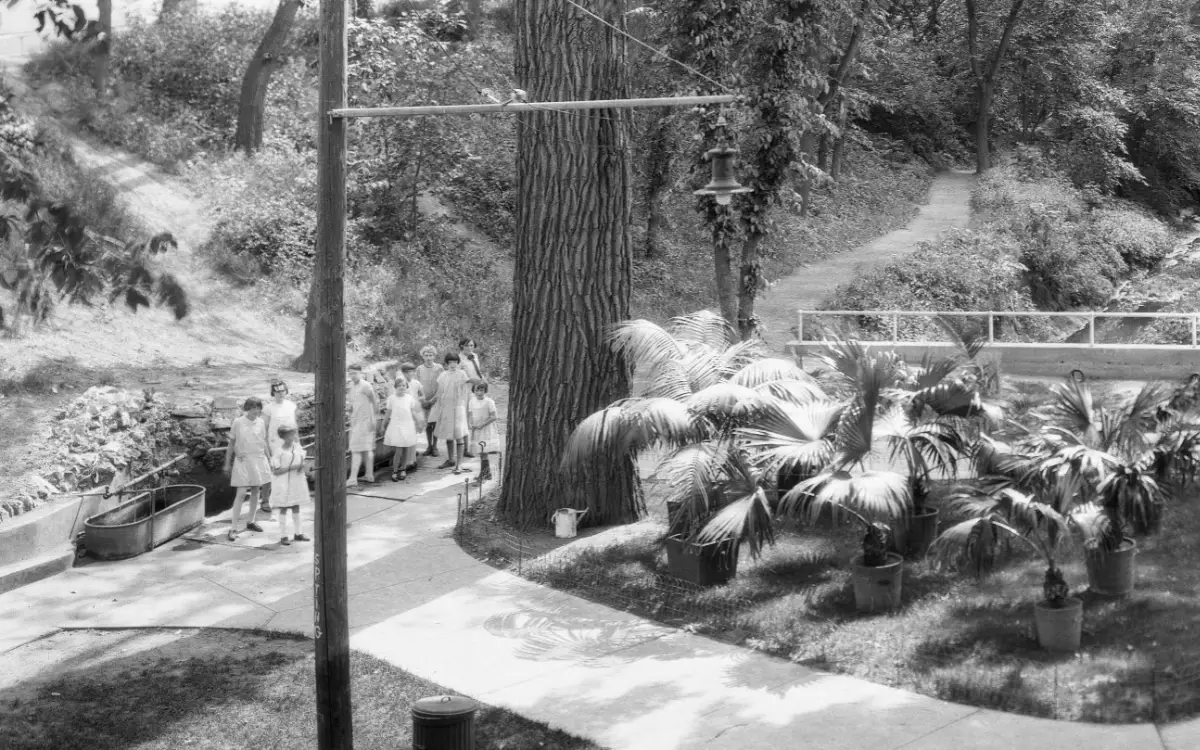
The city council settled on land that included a wooded ravine that followed a small stream known as Patrick’s Run. The area also contained impressive elm trees for which the park was named. Another notable feature was the rock-walled spring with sparkling water from the hillside stream. Residents lined up to fill empty jugs with the refreshing water that was said to have originated in the Black Hills. It was so popular, in fact, that people often had to wait in line for up to 30 minutes to get their turn.
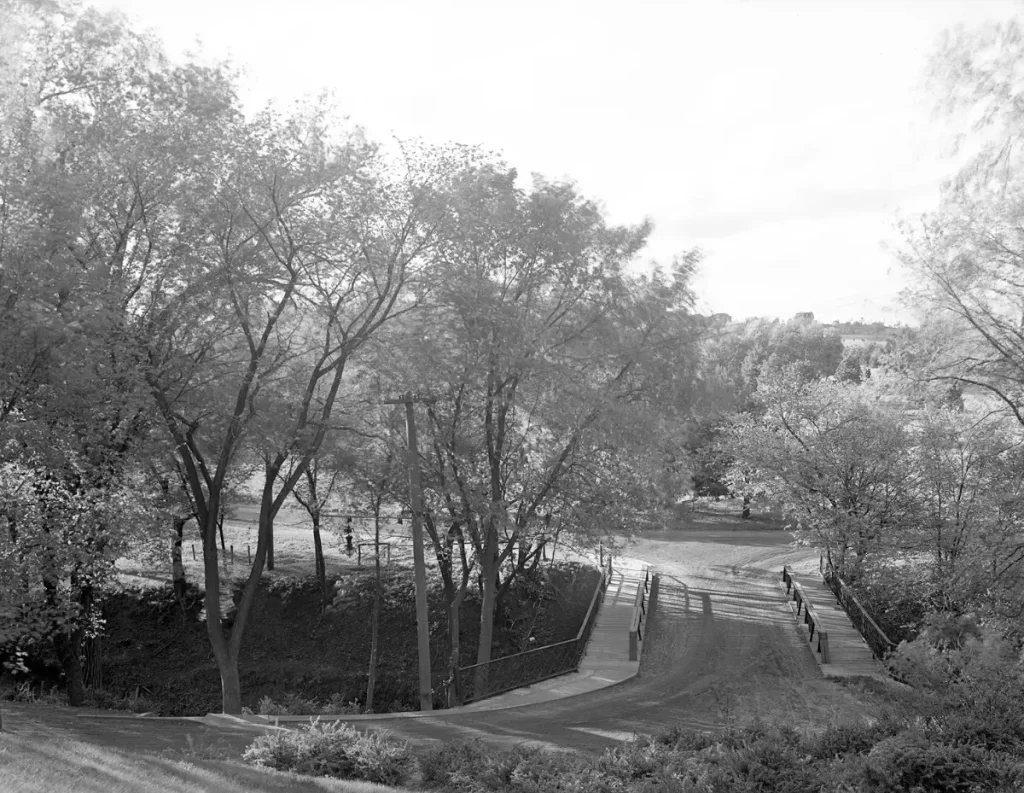
1915 photo of the Jones Street Bridge used to enter Elmwood Park.
Photo courtesy of Durham Museum photo archives
By the time the city hired Cleveland, it had acquired the first 55 acres for Elmwood Park, with the initial parcels donated to the city. Since it was three miles west of downtown, it was only accessible by buggy or on foot. To allow for easy access to the park, three bridges were constructed over the ravine. It wasn’t until the streetcar line was extended along Leavenworth Street to the park entrance in 1910 that it became accessible to the masses.
Noted architect F. A. Henninger designed a pavilion that resembled a Spanish mission that was completed in 1909, and by 1916, an 18-hole public golf course was established adjacent to the park. Since the course didn’t have a clubhouse of its own, golfers bought and remodeled a nearby house to serve as such the following year. The house still stands at 5912 Leavenworth Street.
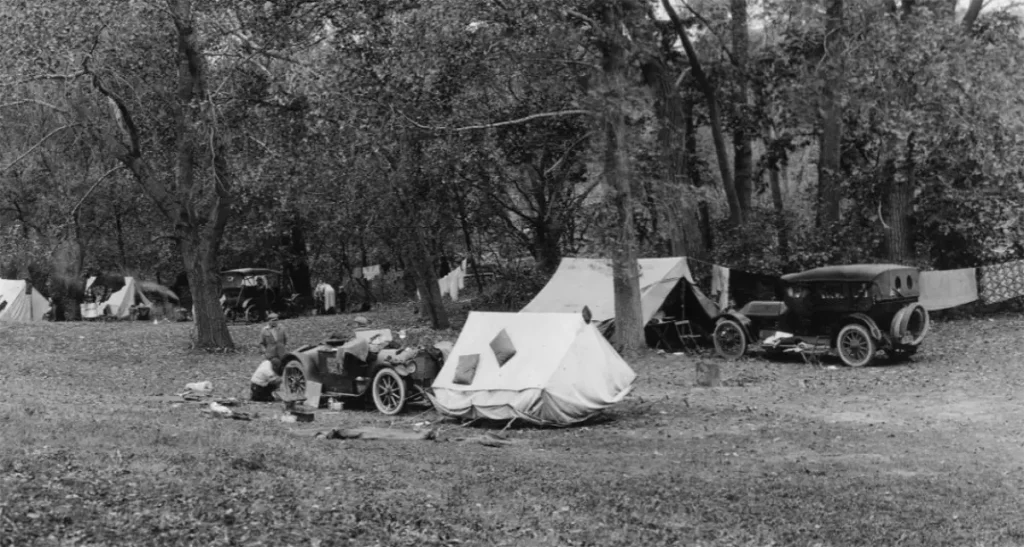
1920 photo of the auto camps inside Elmwood Park.
Photo courtesy of Durham Museum photo archives
By the time auto tourist camps grew in popularity, the park had grown to 215 acres. It also featured an auto tourist camp that was situated on high ground and overlooked the rest of the park. With plenty of trees to provide shade and space to accommodate 150 cars, the camp at Elmwood Park proved to be popular with those traveling across the country. Amenities included a cookhouse, telephone, bathrooms and an assembly room with writing tables, fireplaces, maps and stationery. The cost was 50 cents per day for a maximum of four days. At its peak in the mid-1920s, more than 7,000 cars stopped at the camp. When it closed in 1933, the buildings that served the campers were converted into a proper clubhouse for the golf course.
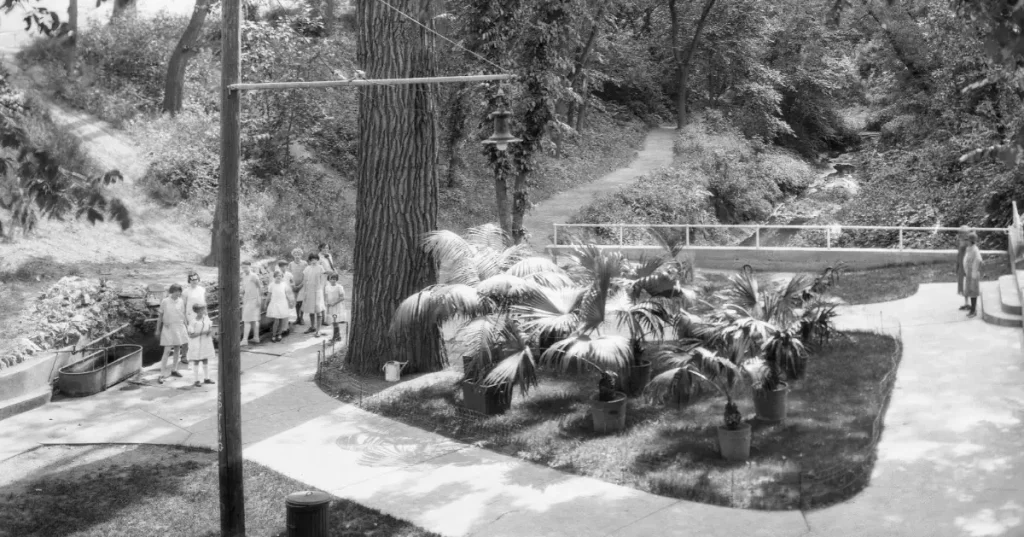
1926 photo of people waiting for water at the spring inside Elmwood Park.
Photo courtesy of Durham Museum photo archives
The park also contained works of art. One was a bronze baseball statue erected by the Omaha Amateur Baseball Association and created by the American Art Bronze Company in Chicago. Donated to the city, the statue named Bosco sat upon a granite pedestal. It became known as “Mr. Strikeout” and was so poorly designed that it drew ridicule, as no one could determine whether the batter was right-handed or left-handed, whether it represented a hit or a strikeout, or even who the player was. Its time at the park was short-lived, as it was sent to the World War II scrap drive in 1942.
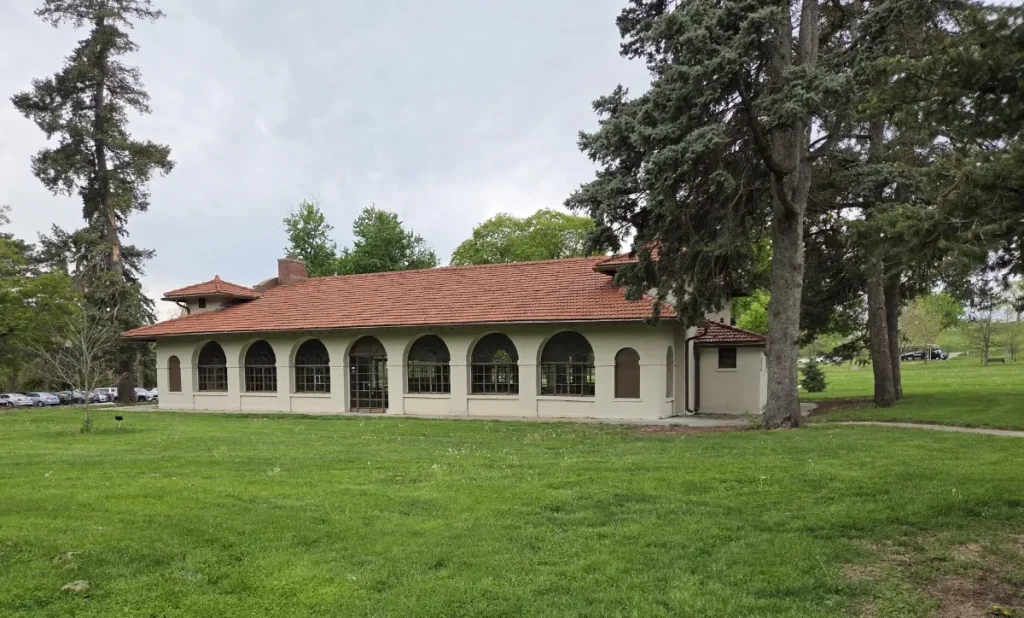
2026 photo of the Spanish-style pavilion inside Elmwood Park.
Photo courtesy of Omaha Exploration
Next to Bosco sat a totem pole that was purchased from Native Americans in Alaska in 1909 and donated to the library in 1921 by Ralph Sunderland. The totem was relocated to Hummel Park after World War II and disappeared a few years later.
After seeing monkeys in a park in Minneapolis, parks commissioner Frank E. Frost decided that Elmwood should also have monkeys. To that end, he created Monkey Island in 1933. The island was surrounded by a three-foot-deep moat that was designed to keep them in. It didn’t take them long to figure out it wasn’t difficult to traverse the moat. Frost considered putting alligators in the moat to keep them in but instead settled for a deeper moat and stronger barrier. Within three years, the monkeys were relocated to Riverview Zoo.
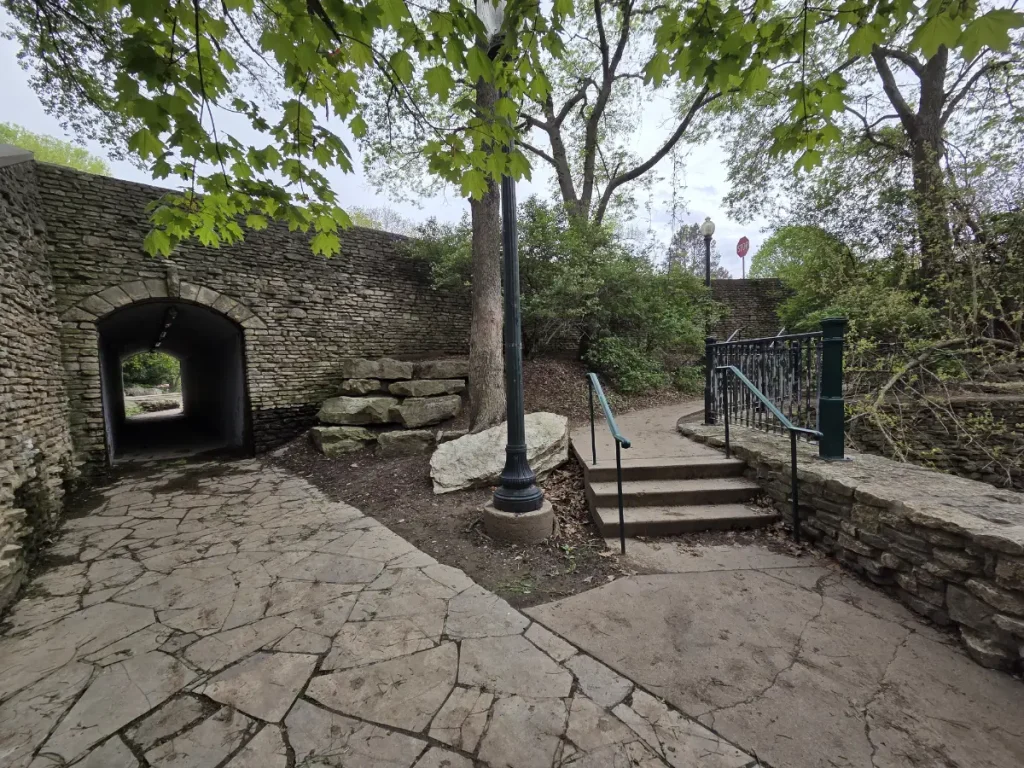
2026 photo of the grotto next to the creek inside Elmwood Park.
Photo courtesy of Omaha Exploration
By 1937, the University of Omaha decided to relocate its campus from North Omaha to the western edge of the park. The university continued to grow and suggested that it could expand to the east. Fortunately, the park was saved as a result of rulings by the Nebraska Supreme Court. By then the streetcar lines on Leavenworth Street were abandoned, and the city had determined that water from the spring was contaminated and unsafe for consumption.
Neighbors of the park first thought a public swimming pool would be an undesirable feature and prevented it for a number of years until 1964. In 1971, park advocate Rachel K. Gallagher, whose family created Butternut Coffee, filed a lawsuit with three others over plans to use a portion of the park for university parking. They won after a two-year legal battle. Gallagher also led the effort to turn the old Krug Park into Gallagher Park and helped prevent Interstate 80 from cutting through Riverview Park.
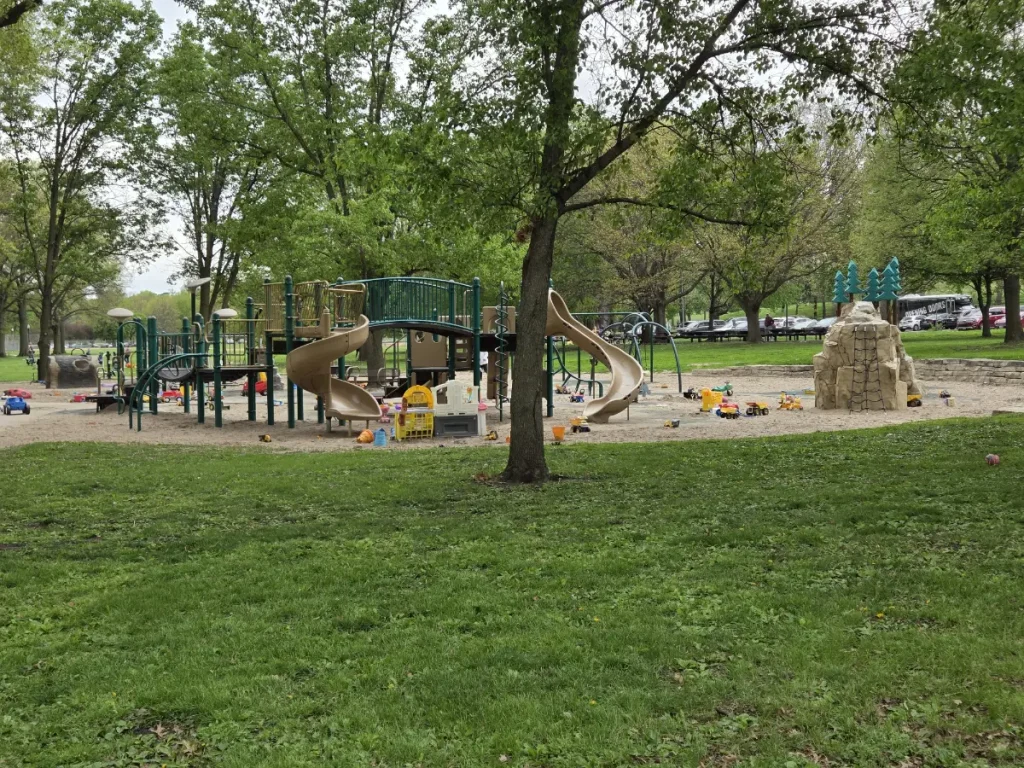
2026 photo of the Sounding Stones sculptures by Leslie Iwai inside Elmwood Park.
Photo courtesy of Omaha Exploration
Deemed unsafe, the last of the old bridges was torn down in 1980 and replaced with a pedestrian bridge using the same inverted truss construction. The grotto, whose water was deemed unfit for drinking in 1947 causing its use to diminish, was restored in 2000. Improvements to the plaza area included lighting, landscaping, stairways and a ramp into the sunken area of the grotto. They also made changes so that the spring water flowed along a trough and into a pool.
While Elmwood Park is not the oldest park in the city – that honor belongs to Hanscom Park – it is among the most popular and most utilized. Today it includes the golf course, swimming pool, pavilion, picnic area, playground, exercise equipment, baseball field and hiking trails.