Sitting at the edge of downtown is a building called the “cupcake” when it was first built. There was nothing like it in Omaha.
The building sits at the northeast corner of 19th & Dodge Street and was designed by Frank (Nes) Latenser of John Latenser & Sons, one of Omaha’s most prominent architectural firms. His grandfather, John Latenser Sr., founded the business in 1885, and by the 1930s the firm had designed at least one building in 89 of the 98 blocks that composed downtown Omaha.
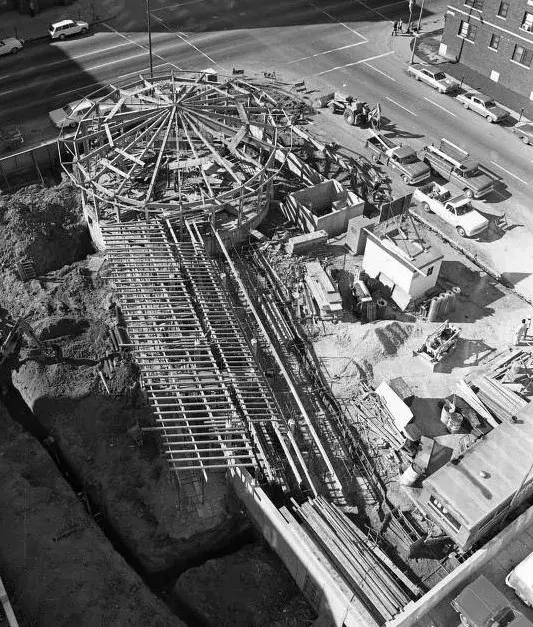
Photo courtesy of Durham Museum photo archives
John Latenser Sr., an immigrant from Liechtenstein, brought his sons John Jr. and Frank into the practice in 1915, renaming it John Latenser & Sons. Frank, a prolific architect in his own right, designed more than 300 buildings in Omaha and became the firm’s second president in 1936 following his father’s death. He retired in 1971 and passed away in 1973.
Nes, Frank’s son, became the firm’s third president in 1966. He left Central High School early to complete an accelerated engineering degree at Iowa State University before serving in the Navy during World War II. Following the war, he pursued graduate studies in city planning at MIT and Notre Dame before joining the family business.
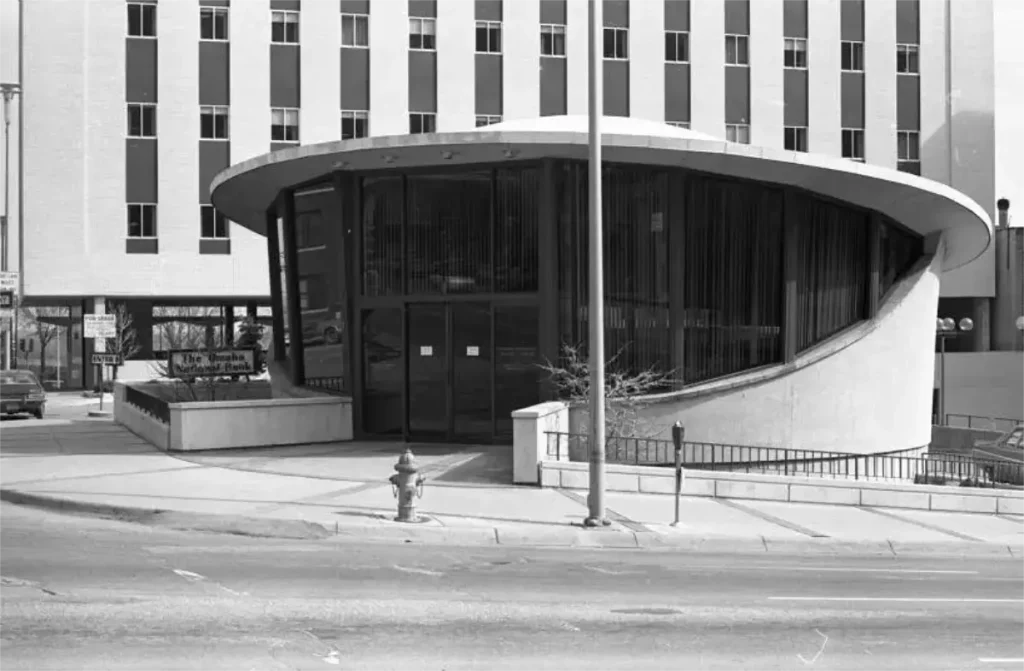
Photo courtesy of Durham Museum photo archives
Family member Paul Latenser said in an interview with the Omaha World-Herald in 2015 that Nes was likely looking into the future when he designed the structure. The space race, which culminated in 1969 when Neil Armstrong and Buzz Aldrin landed on the moon, provided inspiration. Paul said, “Basically, it was a metaphor for automation of the future. That’s how I imagine his intent when he designed the building.”
The cupcake’s circular shape and sweeping lines were no accident. They were meant to contrast with the buildings nearby. Achieving the correct arc for its double-curved concrete shell required the use of a computer, which made news in 1968. Lueder Construction Company handled the build of the two-story structure, incorporating floor-to-ceiling glass panels that covered nearly a third of the building’s exterior wall area.

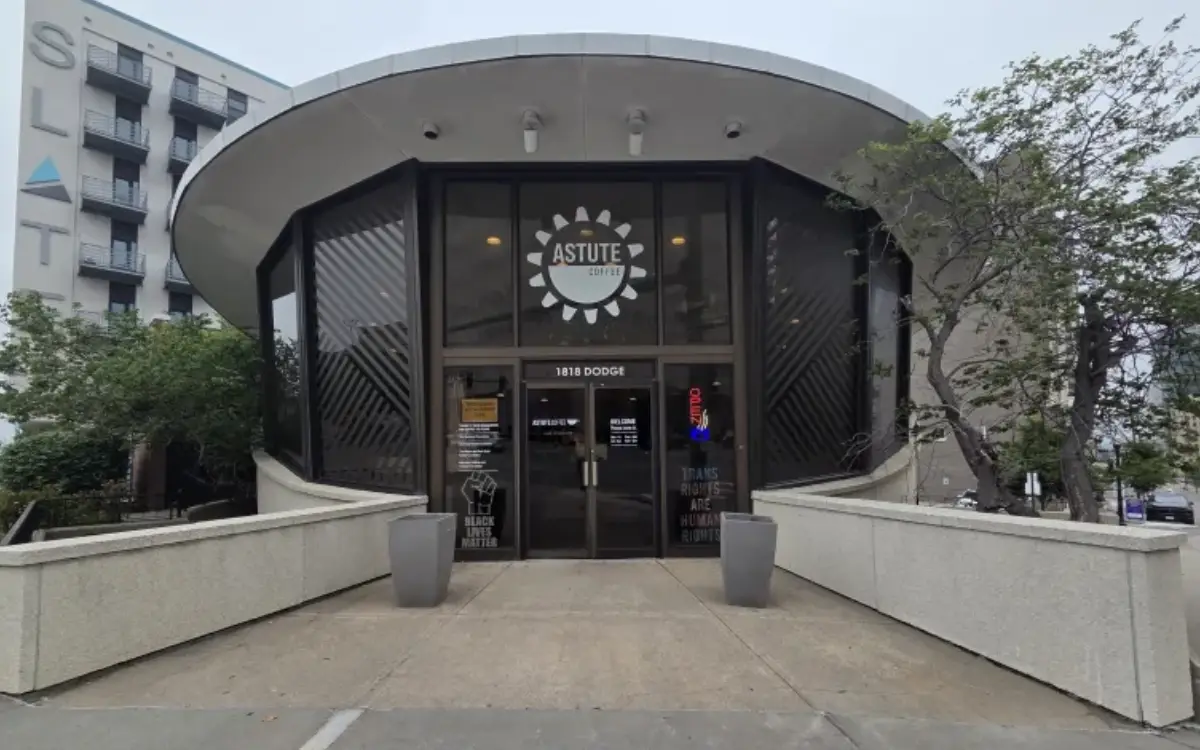
2026 photo of the flying saucer building as the home to Astute Coffee with Slate apartments behind it
Photo courtesy of Omaha Exploration
More commonly referred to as the “flying saucer” today, the framework of the 6,500 sq. ft. building resembled a spiderweb. A bridge leading to its entrance from Dodge Street went over a dry moat landscaped as a Japanese garden below. Its futuristic design won a City Beautification award in 1969 from the Women’s Division of the Chamber of Commerce.
Built for Omaha National Bank, the building at 1818 Dodge Street followed a developing trend of utilizing closed-circuit television for tellers to service its seven or eight drive-through windows. Up to this point, banks had people stationed at each individual teller window.

Photo courtesy of Omaha Exploration
The new branch first opened in 1969 but only served its designed purpose for five years. Omaha National Bank utilized the nearby Omaha Building at 1650 Farnam Street as its headquarters until around 1970, when it moved to the brand-new Woodmen Tower. The saucer then served as a location for Western Union until 1985. Black Hills Energy, which owned the connected high-rise building to the north, used the saucer for training purposes until 2011.
The building sat empty until NuStyle Development bought the high-rise at 1815 Capitol Avenue in 2012. The high-rise had originally been home to Travelers Insurance before becoming Peoples Natural Gas and then Black Hills Energy. The saucer building was part of the purchase.

2026 photo of the entrance to Astute Coffee
Photo courtesy of Omaha Exploration
While NuStyle renovated the high-rise into Slate Apartments, they envisioned the saucer as either a restaurant or coffee shop. It remained empty until 2015, when Bike Union, a nonprofit whose aim was to train and mentor at-risk youth, was looking for a space to operate. Founded by Miah Sommer, a south Omaha native who grew up in poverty and dropped out of high school, he sought to hire young adults who had aged out of the foster care system. According to Jim Casey of Youth Opportunities Initiative, 1 in 5 will end up without a home and fewer than half will find steady work by their mid-20s. The young adults trained as bicycle mechanics and baristas as they learned new skills and received mentorship to help them thrive.
NuStyle appreciated the mission and offered Bike Union a good deal on the lease. The shop essentially served as a place where customers could get their bicycle repaired while enjoying a cup of coffee. NuStyle’s downtown conversion projects had added a large number of residents nearby who would benefit from the shop’s services, and the Slate had a significant number of cyclists among its tenants, making it an added amenity.

2026 photo inside Astute Coffee
Photo courtesy of Omaha Exploration
In 2022, Bike Union changed its name to Astute Coffee after it dropped the bicycle repair component of the business as it shifted focus to its core mission of workforce development. The signage on its wall says it best: “Astute Coffee connects young adults to the workforce and supports their self-sufficiency through personal and professional development programming. When you purchase your coffee from Astute, you are supporting an organization with a purpose.” Well received for both its coffee and its mission, Astute Coffee opened a second location in the Atlas Apartments at 29th & California Street.
While this may be one of the lesser-known buildings in the family’s architectural legacy, it remains one of the city’s most unique structures. Nes Latenser looked into the future when he designed it. Now it’s the young adults serving cups of coffee inside it who are doing the same.