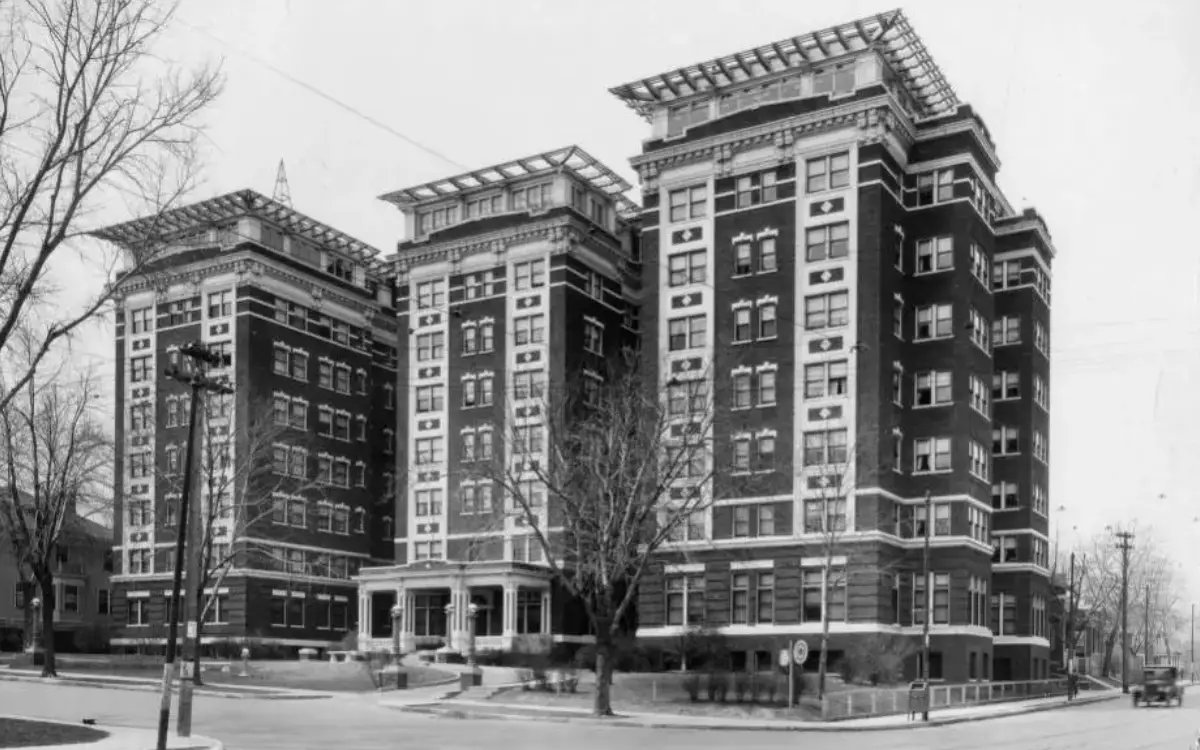
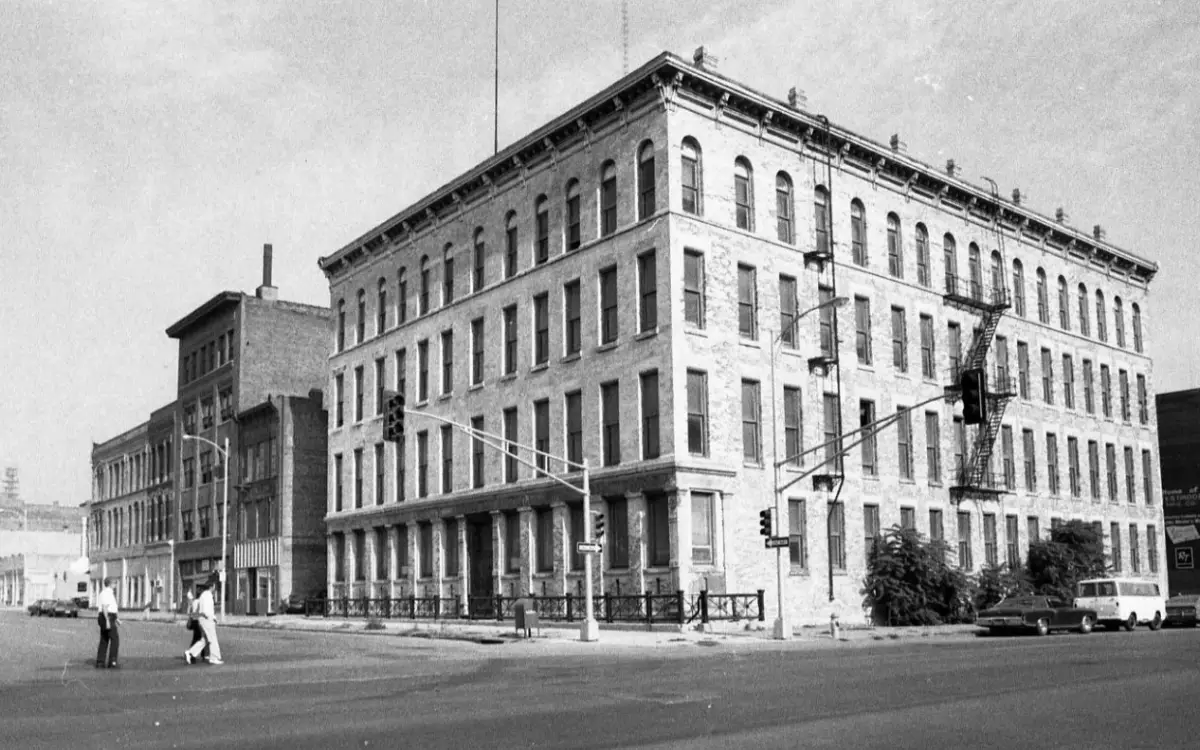
Adjacent to the emerging Flatiron District, the building now known as the Magnolia Hotel first opened as Aquila Court in 1924. Built by brothers Chester and Raymond Cook, it was envisioned as an elegant multi-use destination that combined offices and apartments with retail space around a central courtyard inspired by European design.

Photo courtesy of The Durham Museum
The land on which it was built was first acquired by Aquila Cook and later handed down to his children, George and Ira. It was not until Aquila’s grandsons acquired the land that they decided to build the first of four similar buildings in the Midwest.
Located at 1615 Howard Street, the project was advertised as “destined to be the Michigan Boulevard and the Fifth Avenue of Omaha’s shopping life.” Hailing from Chicago, the Cooks hired the architectural firm Holabird & Roche to design it. Raymond insisted that the two buildings be constructed around a central courtyard so that it resembled similar structures in his hometown. To complete the project, they also hired many specialized craftsmen from Chicago.

Photo courtesy of The Durham Museum
The U-shaped building, which features the faces of Aquila and George on its facade, was inspired by the Bargello in Italy. Its exterior was faced with Bedford limestone, while the interior courtyard walls were constructed of red brick to create a warmer atmosphere. An arcade surrounded the courtyard, serving as a screen and protected walkway for the surrounding businesses. The courtyard itself resembled an Italian garden, with stone paths, pools containing goldfish, canals, and numerous plants. Raymond personally supervised the layout and plantings.

1952 Aquila Court North Facade Facing Howard St Courtesy of Durham Museum
Photo courtesy of The Durham Museum
The interior of the building used luxurious materials, including mahogany woodwork, terrazzo marble flooring, black marble, and imported travertine. It also featured modern amenities such as electric elevators and steam heating. The building became a symbol of both innovation and craftsmanship.
The structure stood out from others in Omaha because of its unique layout. The northern and eastern wings contained both retail and office space. Combined, it had 18 street-level retail stores and 240 offices on the upper floors. These stores had entrances facing both the street and the interior courtyard. The offices attracted professionals, including physicians, dentists, and artists. Each of the upper floors featured a different motif, ranging from Spanish on the second floor to French Provincial on the third and Mediterranean on the fourth.

Magnolia Courtyard
Photo by Patrick Wyman
The southern wing contained 19 two-story studio apartments, each with a bedroom, living room, and balcony overlooking the courtyard below. This wing also included a tearoom and four specialty shops. The apartments were accessed from within the courtyard, which had an entrance along 17th Street. The courtyard served not only as a tranquil oasis but also as a buffer between the two buildings.

Magnolia Hotel Lobby
Photo by Patrick Wyman
The Cook family maintained ownership of the building until 1956. Union Casualty Company was already using a portion of the building for its offices when it purchased the property in 1970. Afterward, Fred Winkelmann, the insurance company’s president and a real estate developer, began an extensive renovation. This work included removing the pools and canals in the courtyard and covering the area with marble slabs, fountains, and an ornamental waterwheel. The building was added to the National Register of Historic Places in 1974.

Photo courtesy Magnolia Hotel
After Winkelmann retired, both Union Casualty and Aquila Court were sold to Ellsworth Financial in 1986. The Chicago-based company was unable to adequately maintain the building, which led to roof and drainage issues. Real estate developer David Slattery acquired the building in 1992. After it was used as Omaha’s Symphony Designer Showhouse, he began a nearly three-year project to repair, renovate, and convert it into a hotel. At that time, it was the only remaining Aquila Court building in the country. The others had been located in Chicago, Cleveland, and Columbus, Ohio. Following its latest renovation, it opened as the Westin Aquila in 1996.
During the renovation led by Alley Poyner Architecture and Lund-Ross Constructors, a long-hidden mezzanine was discovered above what would become the registration desk and piano area. Other discoveries included a roster of former tenants on a wall connecting the lobby to the guest suites, a brass and glass mail slide visible from the elevator area on each floor, and a chandelier.

Magnolia Hotel Restaurant and Bar
Photo by Patrick Wyman
At the time, it was only the third Four Diamond hotel in Nebraska, joining the Omaha Marriott and the Cornhusker Hotel in Lincoln. It was featured in Forbes and Great Hotels and Resorts magazines, as well as USA Today and The New York Times, and was inducted into the Historic Hotels of America program. The hotel featured meeting rooms, a grand ballroom, and a full-service restaurant called E. David’s, along with a lounge named Dr. Eugene’s Pub in honor of Slattery’s grandfather, who had maintained a dentist’s office in the building for more than 40 years.

Magnolia Hotel North Facade Facing Howard St
Photo by Patrick Wyman
The hotel became part of the Sheraton chain in 1999 and later the Magnolia brand in 2006. The 145-room boutique hotel also included 21 suites and a Presidential Suite, along with a bar that offered live entertainment and a library where guests could select books, use a computer, or hold small meetings.
Today, the Magnolia Hotel and its courtyard are popular venues for weddings and other events. It was named runner-up for Best Hotel in the 2025 Omaha Metropolitan Area Tourism Awards.