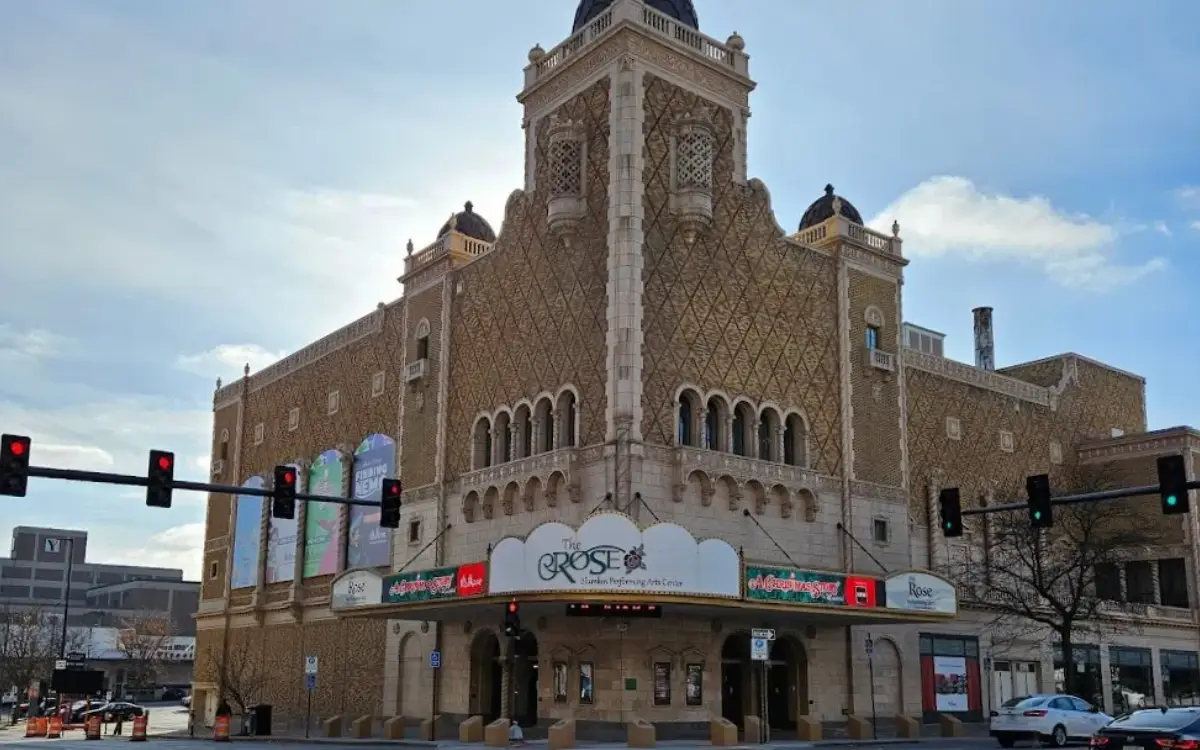
There’s nothing like the Rose Theater in Omaha. It catches your eye every time you make the drive along Farnam Street downtown.
The ornate structure at 2001 Farnam Street was built by A. H. Blank, a Romanian immigrant who settled in Council Bluffs before making his way to Omaha. It was the man who worked as a carnival barker at the Trans-Mississippi Exposition in 1898 before becoming a balloon and novelty salesman who built one of the city’s most extraordinary buildings.
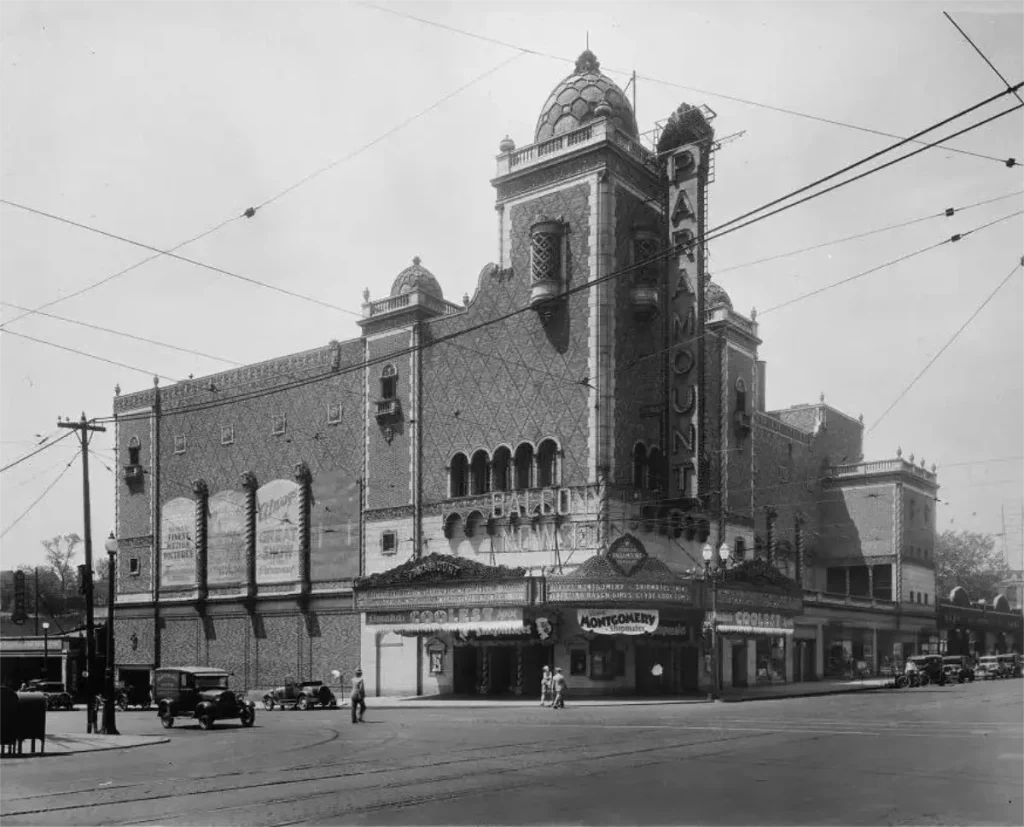
1931 Durham Museum photo of the Rose Theater after it became the Paramount Theater
Photo courtesy of Durham Museum photo archives
Blank founded the Central States Theater Corporation, through which he owned and operated several theaters across the Midwest. He hired John Eberson, a prolific designer of theaters across the country, to design the Riviera with its unique combination of Moorish and Italian Renaissance architecture.
The interior matched the grandeur of its facade with tapestries, oriental rugs, friezes, intricate mosaic tile flooring, fountains and Mediterranean-style murals. Inside, perfect acoustics and sweeping balconies complemented a ceiling fitted with electric stars and clouds. The theater’s 2,776 seats also supported a full orchestra for song and dance acts, vaudeville skits and feature films.
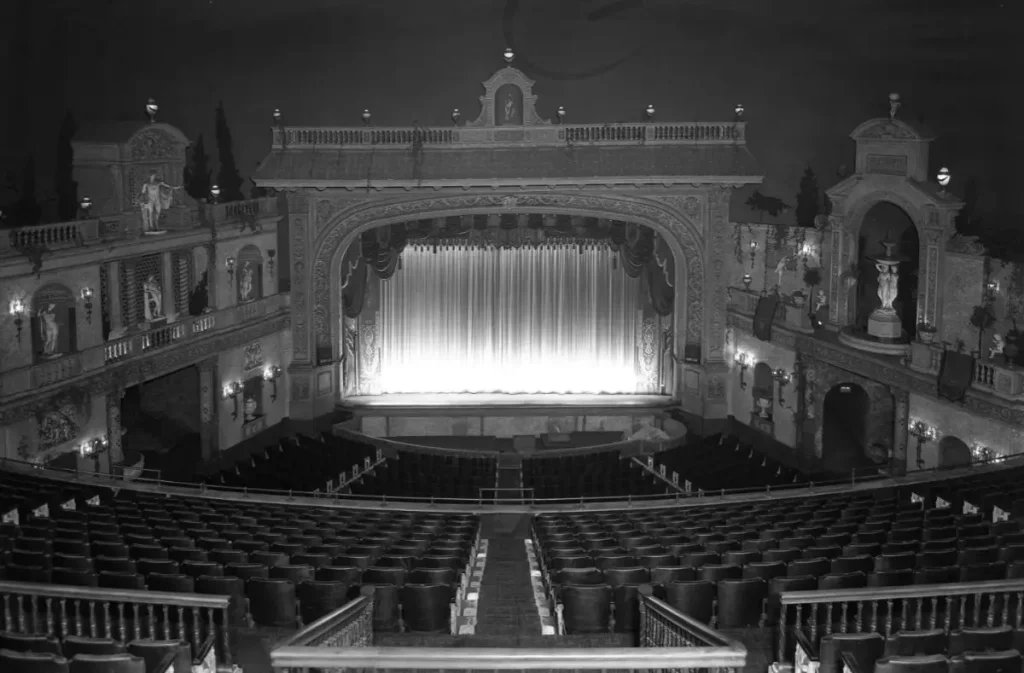
1945 Durham Museum photo of the view of the stage of the Paramount theater from the upper balcony
Photo courtesy of Durham Museum photo archives
The theater opened its doors in 1927, but its founder’s dreams came to a screeching halt with the stock market crash of 1929, just two years after it opened. Blank was forced to sell, at which point it was renamed the Paramount Theater. In an effort to attract new customers, the new owners went so far as to install a miniature golf course in the main lobby. It didn’t go as planned, as the theater opened and closed seven times from 1937 to 1952.
Creighton University had already owned the land when it purchased the building in 1960. The school first considered using it as its own performing arts center before finding it unsuitable for its needs. Instead, the old theater became home to the Omaha Packers professional bowling team in 1961. It was at that point that they ripped out some of the seats and installed four bowling lanes. The Packers folded two months into their first season while the National Bowling League went belly up the following year.
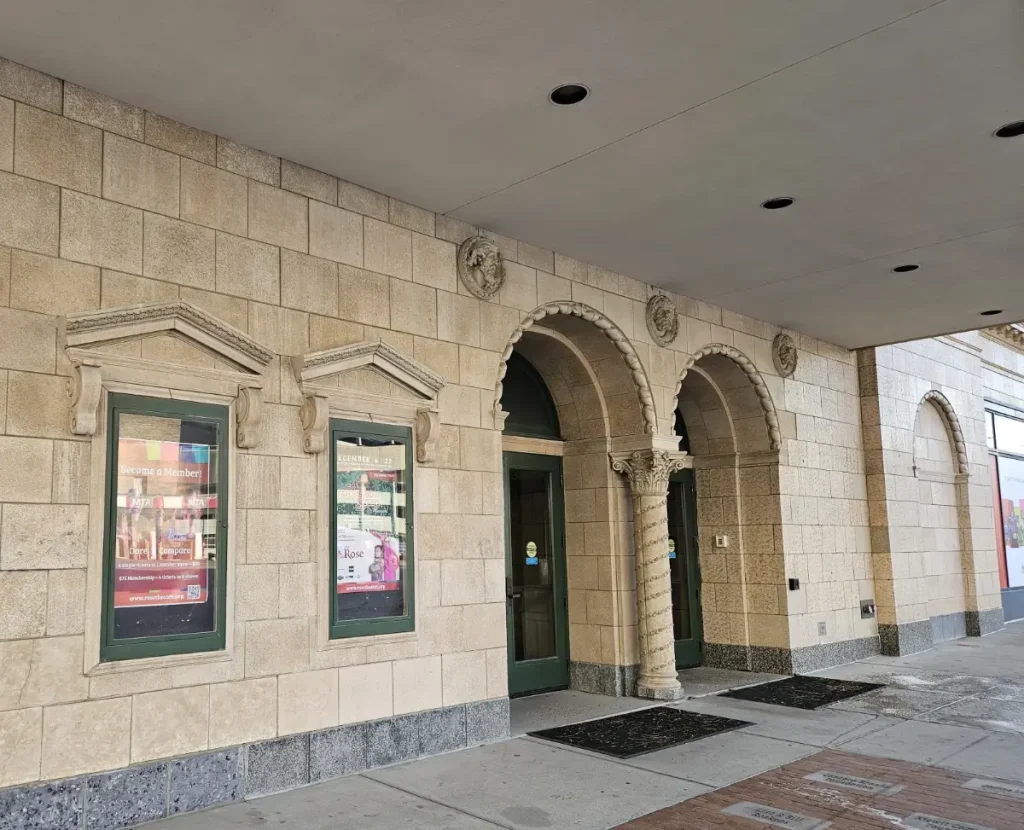
2024 OE photo looking west from Farnam Street at the entrance to the Rose Theater
Photo courtesy of Omaha Exploration
Blank’s old theater found new life in 1962 after Creighton leased it to Dubinsky Brothers Theaters. In the process of remodeling, they removed much of the lavish decor. Its new name, Astro Theater, was in honor of astronaut John Glenn’s orbit of the Earth that same year. The renovated theater had 1,500 seats, much fewer than the 2,776 it had when it first opened. This iteration of the theater remained open until 1979.
By that time, Creighton was desperate to get rid of the building, which was expensive to maintain. When the Federal Reserve Bank expressed interest in tearing it down and replacing it with a new building, there was a public outcry to save it. Enter Rose Blumkin, who often admired the building as she drove past it on her way to Nebraska Furniture Mart, which she founded decades earlier.
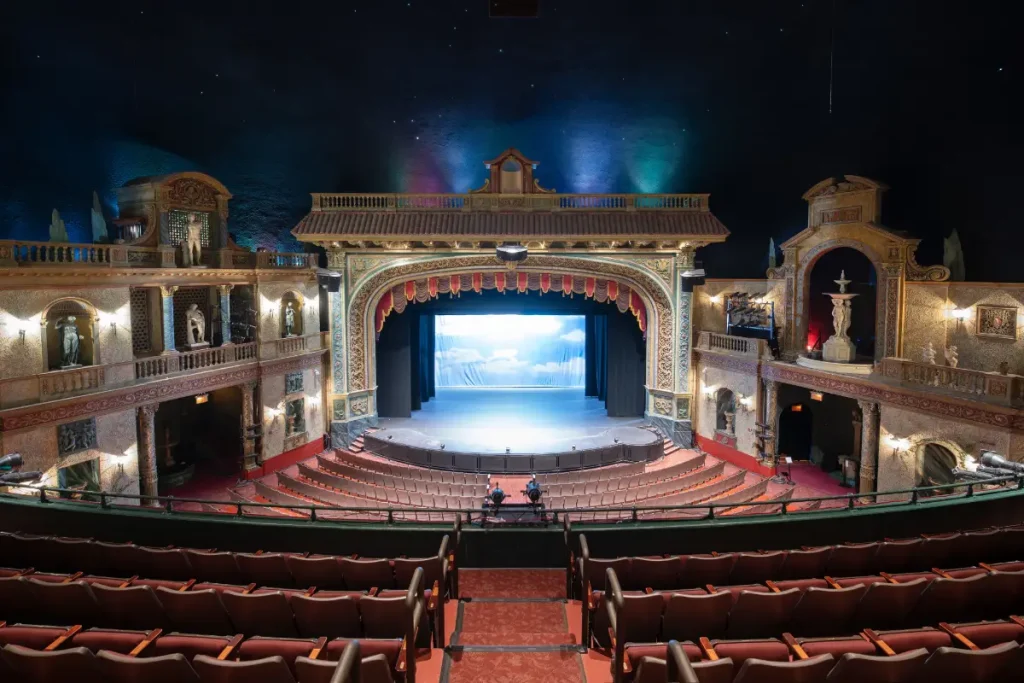
Recent photo of the stage inside the renovated Rose Theater
Photo courtesy of the Rose Theater
Blumkin had a strong attachment to the building where her five-year-old daughter, Frances, won a $5 gold piece for singing and dancing to the song “Am I Blue” in a talent show during the Great Depression. Upon hearing of its imminent destruction in 1981, Blumkin told one of her daughters to “go buy it” no matter the cost, likely saving it from the wrecking ball. The Federal Reserve opted to build next door where the old Nebraska Furniture Mart store used to sit.
Listed on the National Register of Historic Places in 1974 and named an Omaha Landmark in 1980, it wasn’t until 1993 that the Blumkin family donated the building to the Emmy Gifford Children’s Theater. The family also contributed the first $1M toward its renovation under the condition that the theater secure the remaining funds for a full restoration and an endowment for maintenance and repairs. Susie Buffett, daughter of Warren Buffett, led the fundraising campaign as president of the Rose Blumkin Performing Arts Center Foundation to complete a full renovation of the building.
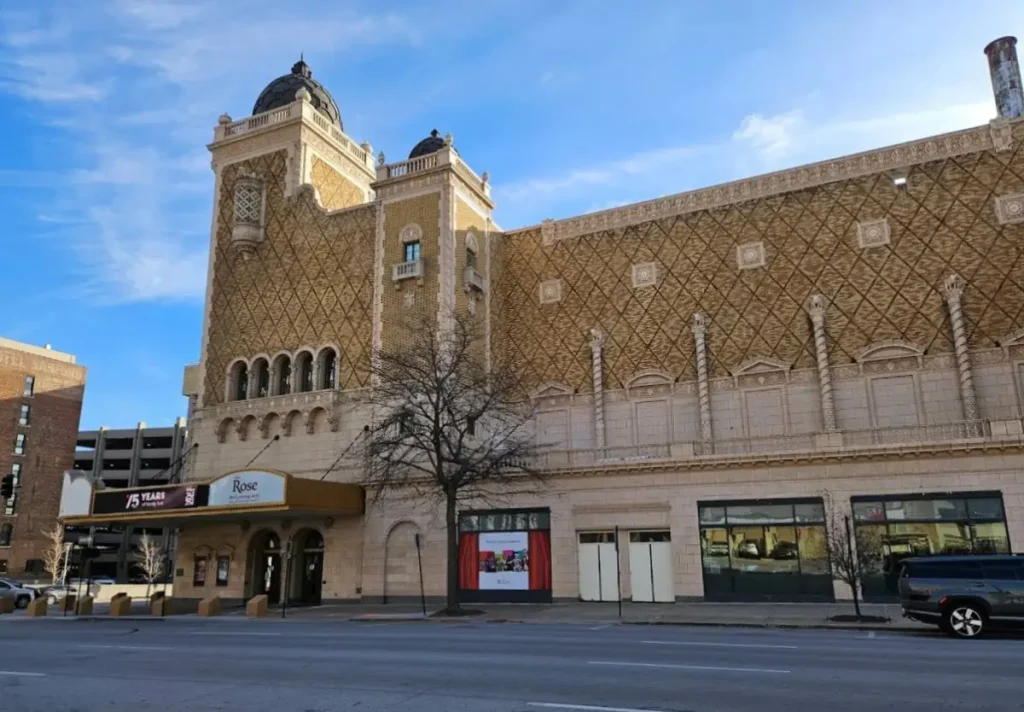
OE photo looking at the north side of the Rose Theater from Farnam Street. Credit: Photo courtesy of Omaha Exploration
Photo courtesy of Omaha Exploration
The children’s theater had been in existence since 1949 and performed in area high schools over its first 25 years. By the mid-1970s, they found a permanent home at the former Center Theater at 3504 Center Street. The intent of the restoration was to keep the theater consistent with architect John Eberson’s original vision. The renovation did just that in addition to adding classrooms, administrative space and bringing it up to code.
The restoration of its majestic ceiling with its clouds and twinkling stars would have to wait until 2007, when the Ahmanson Foundation donated the money to re-add those elements. The Omaha gift stands out, as the foundation established by Central High School alum Howard Ahmanson Sr. typically directs its philanthropy toward the Los Angeles area, including the famous Ahmanson Theatre.
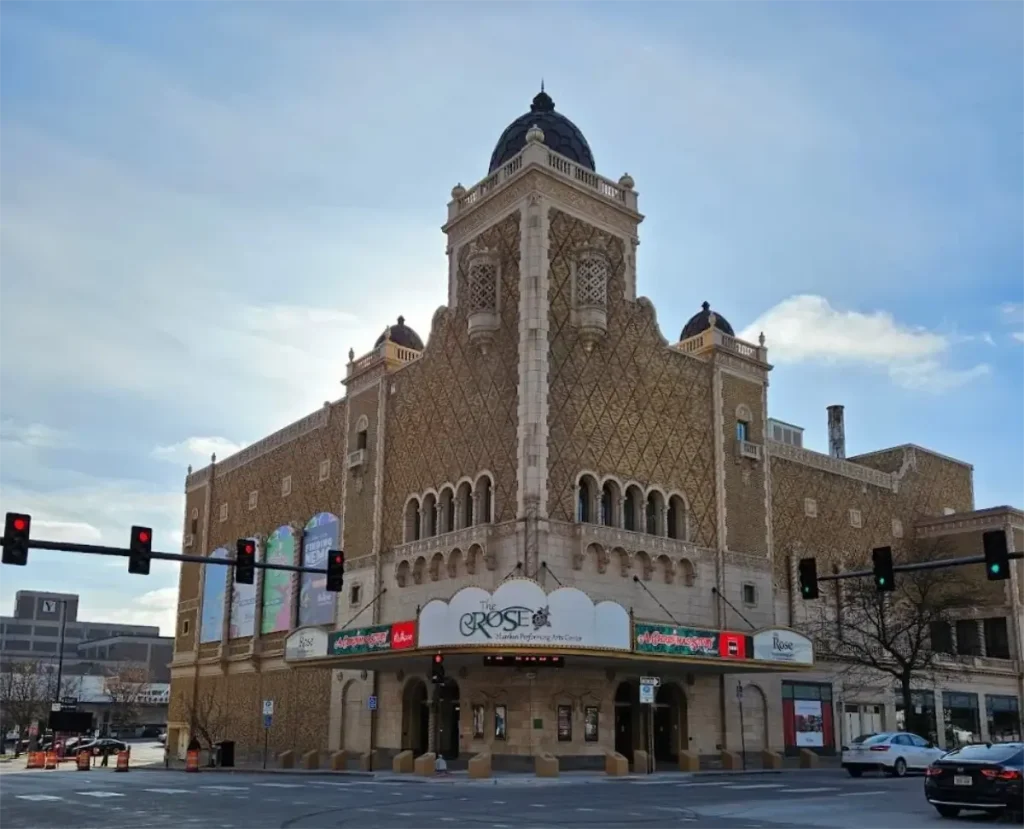
2024 OE photo of the Rose Theater on 20th and Farnam Streets
Photo courtesy of Omaha Exploration
In honor of Blumkin’s generosity, the theater was renamed the Rose Blumkin Performing Arts Center when it reopened in 1995. More commonly referred to as the Rose Theater, it continues to serve as the home to the children’s theater and is considered one of the best in the country. Its professional actors take the stage for audiences under the age of 13. In addition to its wide variety of shows, the Omaha Theater Company also offers classes, camps and workshops.
It was the vision of A. H. Blank that gave the city one of its most extraordinary buildings. It is because of Rose Blumkin and Susie Buffett that it still stands as a place for children to appreciate live theater beneath the stars.