Just two buildings were saved when the city embarked on its plan to build Central Park Mall. The first is the former Nash Block at 9th & Farnam Street, a holdover from Jobbers Canyon. The second is the former Burlington Headquarters Building just one block west.
Located at 1004 Farnam Street, the Burlington building was built in 1879 as the new headquarters for the Burlington and Missouri River Railroad. Founded in Iowa in 1852, the railroad incorporated a Nebraska branch in 1869, at which point it began construction from Plattsmouth to Lincoln. It was acquired by the Chicago, Burlington and Quincy Railroad in 1872, and over the next 20 years, the CB&Q continued laying track across Nebraska, ultimately operating more track in the state than any other railroad with 2,870 miles.

1882 photo of the Burlington Headquarters before its renovation in 1899.
Photo courtesy of Durham Museum photo archives
The railroad hired architect Alfred R. Dufrene to design the building. His other work included Creighton College, and through his firm Dufrene and Mendelssohn, the Christian Specht Building on Douglas Street.
Originally designed in the Italianate style, the three-story brick structure had stone trimming, an ornamental cornice and a flat roof. The first floor held two storefronts outfitted with cast iron and plate-glass windows, while the upper floors served as railroad offices, finished in oiled southern pine, with fireplaces and fire- and burglar-proof vaults on each floor.
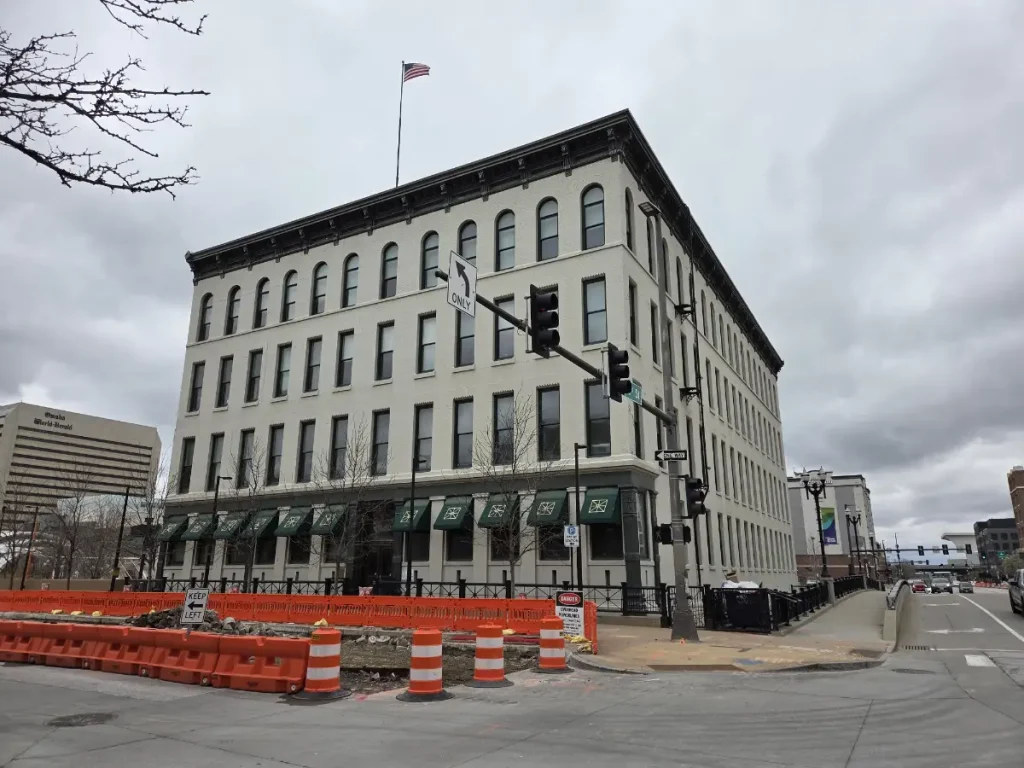
2026 photo of the front of Burlington Place from 10th and Farnam. The barricades in front are for the ongoing streetcar construction.
Photo courtesy of Omaha Exploration
The storefronts were first occupied by Nave, McCord and Brady Wholesale Grocers before later being rented to other wholesale operators. The railroad ran out of office space by 1886, at which point they added a fourth floor and acquired an adjacent lot to expand the building to the west. Architect Thomas Rogers Kimball performed an extensive remodel in 1899, gutting the interior to add a skylight, galleries, open staircases of cast iron and oak and an elevator.
The railroad operated from the building for 87 years, though by 1966, it occupied only half before relocating to the new Capitol Plaza building at 19th & Capitol Avenue. Bernhardt Stahmer purchased it that same year intent on rehabilitating it, resisting calls to tear it down for a parking lot. Unable to find a buyer, he sold it six years later to Harry Weiner of Weiner International Tire and Rubber Company, who used the space for tire storage.

2026 photo of the entrance of Burlington Place facing Farnam Street.
Photo courtesy of Omaha Exploration
The city moved to condemn the building in 1973, but as plans for Central Park Mall (present day Gene Leahy Mall) took shape, its historical and architectural value became harder to dismiss. The city agreed it could serve as a link between the Old Market and the new park with a proposal to lease it for conversion into a restaurant, retail space and offices.
It was added to the National Register of Historic Places the following year. By the time the city agreed to purchase the building in 1976, it was considered an integral part of the new park although none of the interested developers could secure the financing required to convert it due, in part, to high interest rates.

2026 photo looking at the fourth floor inside Burlington Place. The skylight can be seen at the top of the photo.
Photo courtesy of Omaha Exploration
The city ultimately sold it to Ken Wagnon, a Wichita-based developer, in 1981. Wagnon had been involved in redeveloping other historic buildings in the Midwest, including the renovation of Omaha’s Historic Library at 1823 Harney Street.
The building had sat empty for a number of years and was badly in need of repair. Wagnon recalled that it was littered with dead pigeons and contained remnants of fires used by the homeless to keep warm. He told the Omaha World-Herald that despite the building’s awful smell, it was love at first sight and that he absolutely had to have it. Financing most of the project himself, Wagnon put Ameritas in charge of the renovation, having previously partnered with its president John McDonald on other projects. He hired Bahr, Vermeer and Haecker as the architects.

2026 photo inside Burlington Place. The Dale Chihuly “End of Day Chandelier” stands in the center of the atrium.
Photo courtesy of Omaha Exploration
The renovation included replacing the skylight and windows, installing a glass elevator enclosed in an iron cage in the atrium, and repairing the walls, ceiling and floors. In cutting a shaft for a second elevator, crews uncovered a section of railroad track embedded in the concrete. Wagnon also installed a chandelier salvaged from a London building that was destroyed during a World War II air raid.
Michael and Gail Yanney and family donated the “End of Day Chandelier” created by renowned artist Dale Chihuly, which remains on display in the atrium where the skylight casts light upon it. The first tenant in the building, Yanney moved his investment firm in upon completion. He later founded Burlington Capital, which takes its name from the building, and went on to become one of Omaha’s most prominent philanthropists before passing away earlier this year.

2026 photo of the western end of Burlington Place from inside Gene Leahy Mall.
Photo courtesy of Omaha Exploration
While the plans for a restaurant and shops never came to fruition, the building, renamed Burlington Place, was successfully converted to an office complex in 1983. Among the first successful renovations of a 19th century building in Omaha, it was awarded a Landmarks Inc. Preservation Award.
To ensure that it would not meet the same fate as Frankie Pane’s, which was fatally damaged and ultimately razed when neighboring buildings were imploded in 2002 to make way for the Holland Performing Arts Center, the city took precautions including measuring the vibrations when the Gene Leahy Mall was renovated starting in 2019.

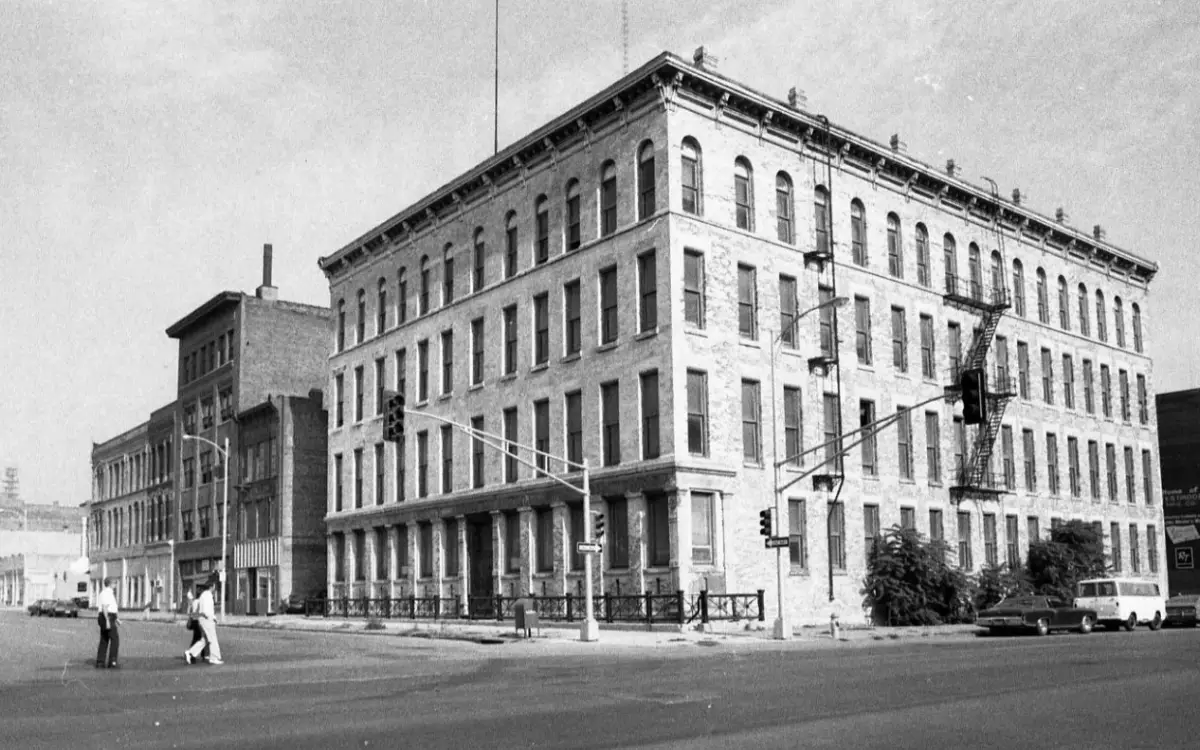
1973 photo of the former Burlington Headquarters after the railroad moved out and before it was renovated for use as an office complex.
Photo courtesy of Durham Museum photo archives
More than 140 years after the Burlington and Missouri River Railroad broke ground on its headquarters, the building they left behind remains one of downtown Omaha’s best preservation stories. Surrounded on three sides by Gene Leahy Mall, its bright white bricks now serve as a canvas for multimedia light shows as part of the three Riverfront parks that attracted more than two million visitors in 2025.
Given how close it came to becoming a parking lot, it is a remarkable turnaround.