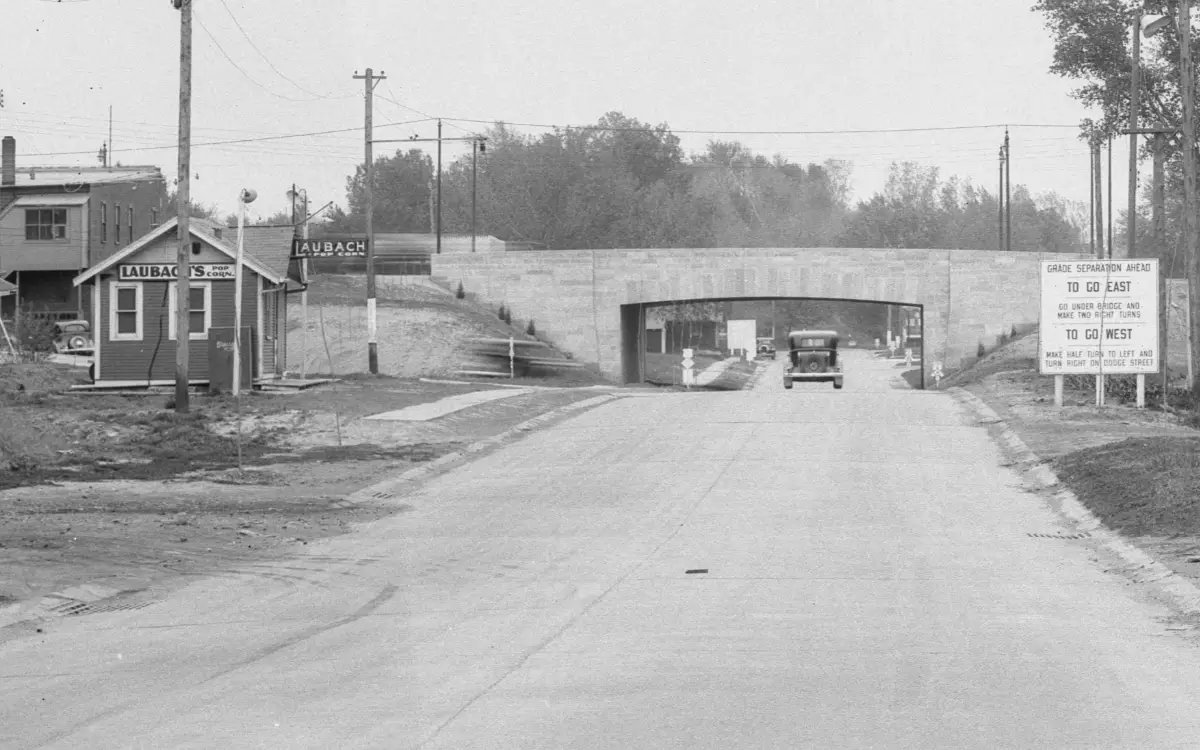
The historic bridge that carries Dodge Street traffic over Saddle Creek Road is scheduled to be demolished in 2029. Named the Saddle Creek Underpass, the bridge was included in a series of ambitious public works projects launched during the Great Depression. The projects were designed to modernize Omaha’s infrastructure while putting residents back to work.
Among these was the Dodge Street Project, which widened the street west of 30th Street into a four-lane thoroughfare extending to the city limits. The initiative also introduced a modern streetlight system and included the construction of two pedestrian subways, as well as the Saddle Creek Underpass.
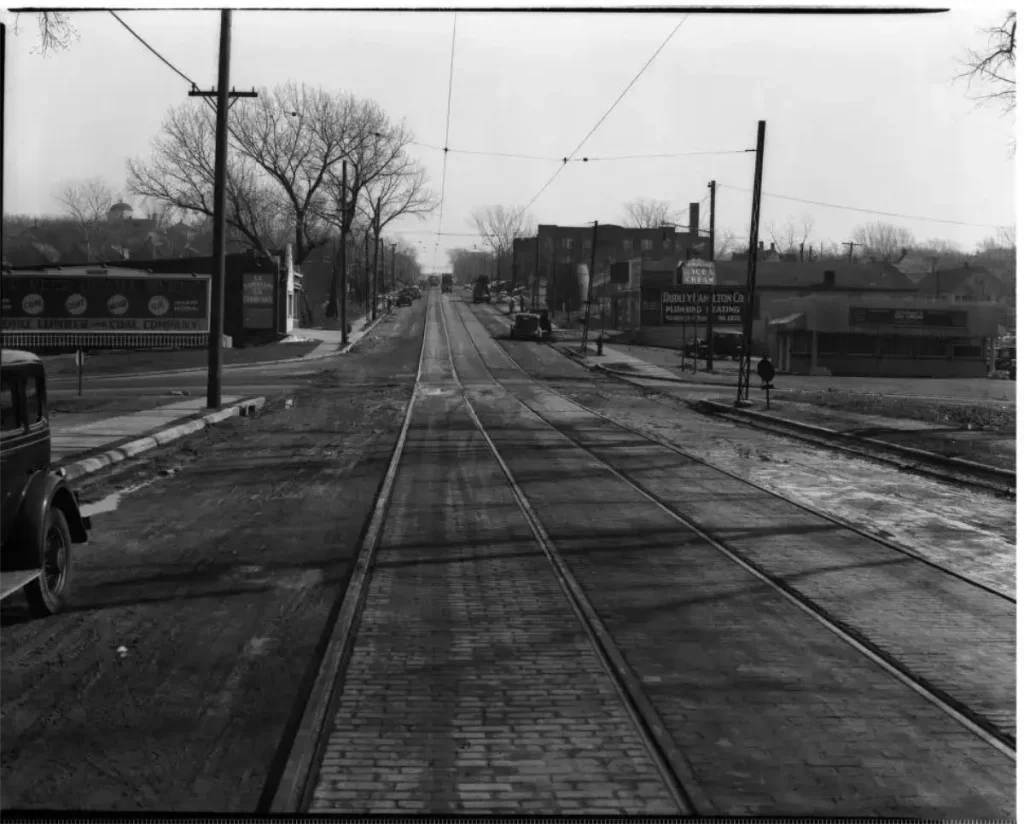
1919 Durham Museum photo looking east from 45th and Dodge before the Saddle Creek Underpass was constructed.
From the Bostwick-Frohardt/KMTV Photograph Collection, permanently housed at The Durham Museum.
In order to build the Saddle Creek Underpass, construction crews first had to excavate the 1,175 cubic yards of dirt needed to lower what was then referred to as Saddle Creek Boulevard. They also had to ensure that the transcontinental telephone cable that ran beneath Dodge Street was not disturbed. Completed in 1934, the 72-foot bridge was constructed with the help of the Civil Works Administration. The distinctive concrete rigid-frame construction was relatively new at the time.
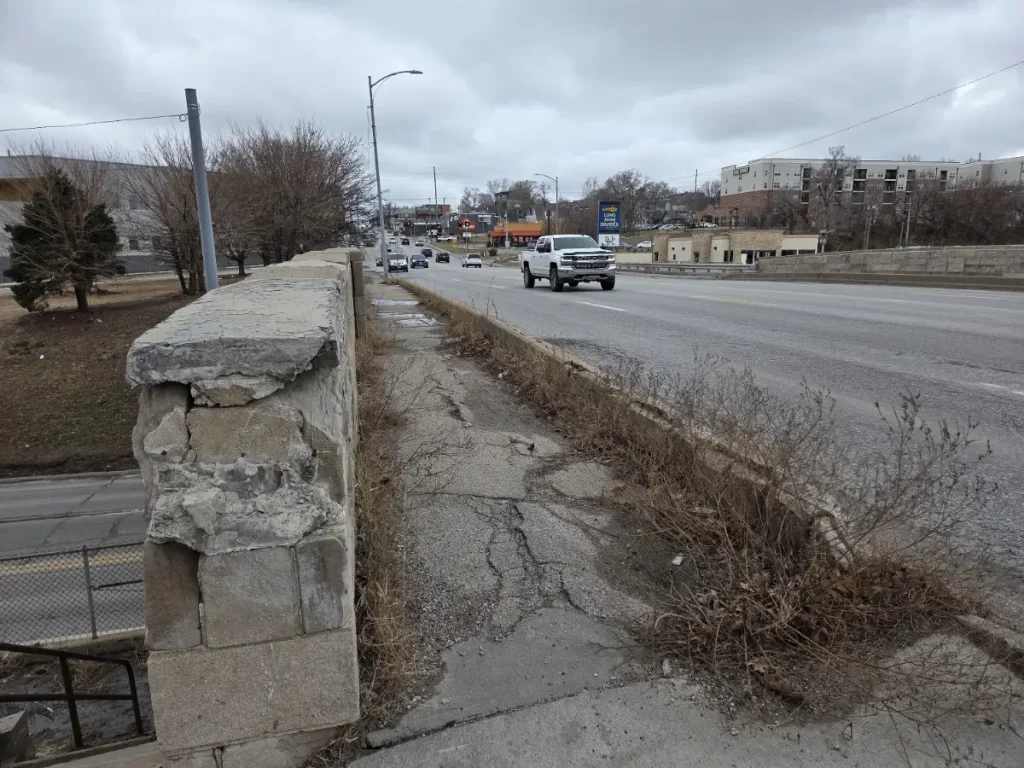
2026 photo looking west from the south side of the Saddle Creek Underpass. Credit: Courtesy of Omaha Exploration.
Courtesy of Omaha Exploration.
According to the Nebraska Department of Roads’ 1933-1934 Biennial Report which summarized its activities, expenses and projects, the bridge’s slab took the form of a very flat arch with a thin slab at the crown, promoting economy while the curve made it more attractive. The design also incorporated 4,160 sq. ft. of original stone curbing salvaged from Dodge Street which served as part of the original Lincoln Highway. Placement of the stone, which was cut and cleaned by CWA workers, was carefully detailed in plans prepared by the Department of Roads.
While the underpass greatly improved traffic flow for automobiles and streetcars along the increasingly busy Dodge Street corridor, flooding plagued the bridge and the road that ran beneath it from the beginning. Before the road existed, Saddle Creek was a stream that drained from a steep valley. Over time, sewers were installed in the creek bed and then paved over to create Saddle Creek Boulevard.
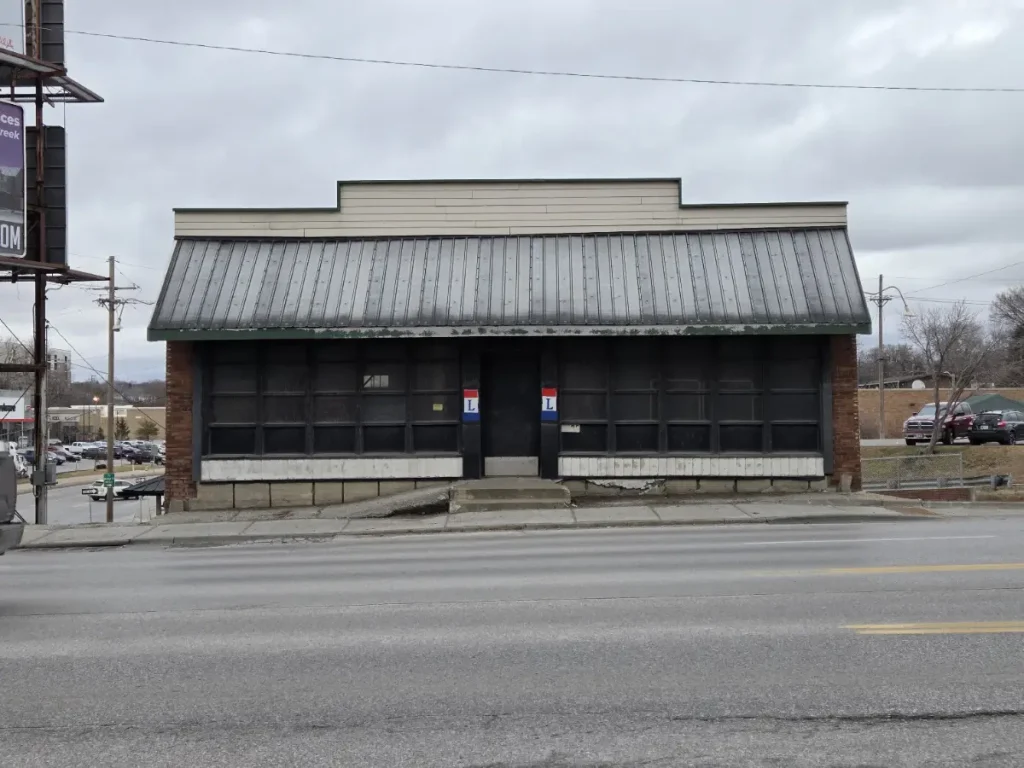
2026 photo of the historic Sutter’s Mill sitting at the eastern end of the Saddle Creek Underpass. The red, white, and blue Lincoln Highway markers were originally used to guide motorists traveling along the highway.
Courtesy of Omaha Exploration.
In 1930, The Omaha Bee-News suggested that constructing a road in the former creek bed may have been a mistake and possibly done without proper authority. While it was initially thought the sewer system would prevent flooding, the problem persisted, occasionally trapping vehicles in rising water beneath the bridge. Today, a “Road May Flood” sign and a measuring gauge warn drivers of the water depth at the underpass.
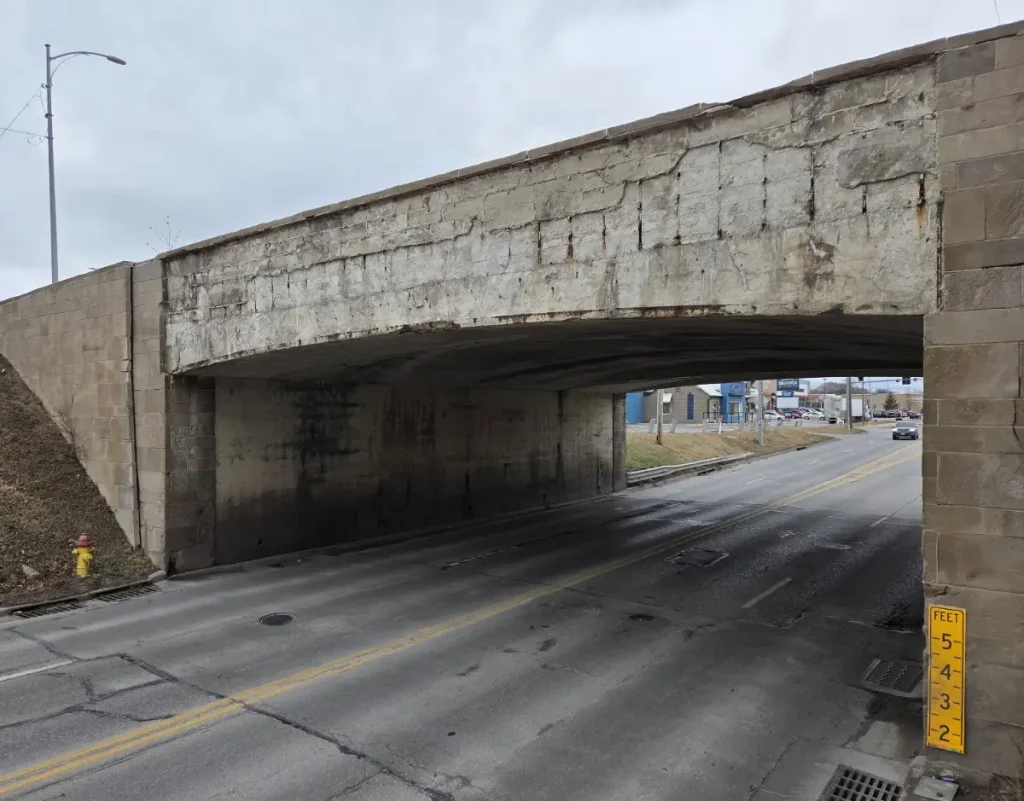
2026 photo of the Saddle Creek Underpass where the decorative stone was removed. Beneath it to the right is the measuring stick that shows how deep the water is when it floods.
Courtesy of Omaha Exploration.
Dodge Street was eventually expanded from four to five lanes with the center being reversible depending on the time of day. The bridge, however, remained largely unchanged. Referred to as Saddle Creek Road by 1960, it was widened to 52 feet while the bridge remained at its original 47-foot width as it was considered to be cost prohibitive. One notable change, however, did take place in 2019 when the decorative curbstone was removed from the south side of the bridge. A crack that formed in the facade raised concerns that falling debris could damage vehicles passing below.
Nils Erickson, owner of the historic Sutter’s Mill located just east of the bridge, said in a 2019 WOWT interview: “They totally destroyed them with a hammer drill. They’re gone in a dump truck, dumped in little bits. They’re irreplaceable. You can’t go back to the 1800s and find 100 curbstones that were destroyed last night in this project.”
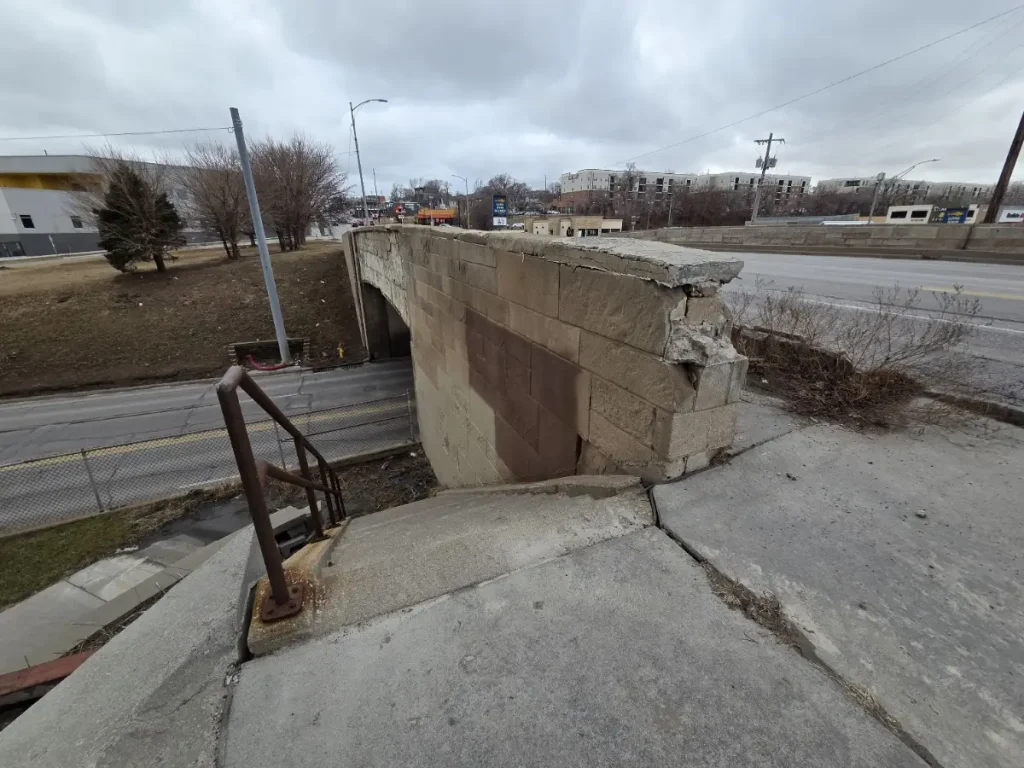
2026 photo looking down towards Saddle Creek Road from the Saddle Creek Underpass.
Courtesy of Omaha Exploration.
Listed on the National Register of Historic Places in 1992, the Saddle Creek Underpass is widely regarded as an excellent surviving example of New Deal-era engineering that remains in daily use for the time being. State plans, however, call for its replacement beginning in 2029. The project is part of a broader effort to maintain infrastructure and improve access along Dodge Street, one of its most heavily traveled corridors.
After it was announced that the city planned to replace it, Erickson told WOWT in 2025 that the nearly century-old bridge represents a piece of the Lincoln Highway. He called its use of the salvaged curbstones Omaha’s first and only successful recycling project, one that the city and state now intend to tear down.
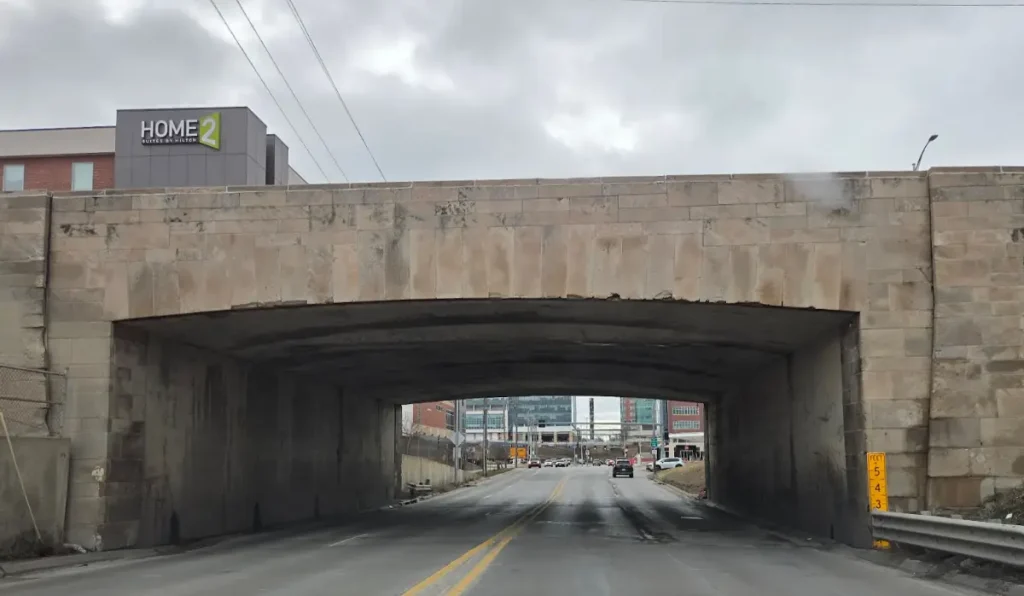
2026 photo of the north side of the Saddle Creek Underpass where the decorative stone remains intact.
Courtesy of Omaha Exploration.
Barbara Gerbino-Bevins of the Nebraska Department of Transportation acknowledged the historic landmark status of the bridge which adds another consideration that they have to account for. She added that there are “several historical societies that are interested in this bridge, so we’ll be working with them to see what the best way may be to preserve that history.”
While the project is still a few years out, the state is trying to figure out how to replace the historic bridge without closing Dodge Street for an extended period of time. One proposal calls for prebuilding the replacement nearby, knocking down the existing bridge, and dropping the new one in place. Gerbino-Bevins added that the replacement will be a simple girder or slab bridge which is easier to build and familiar to contractors.
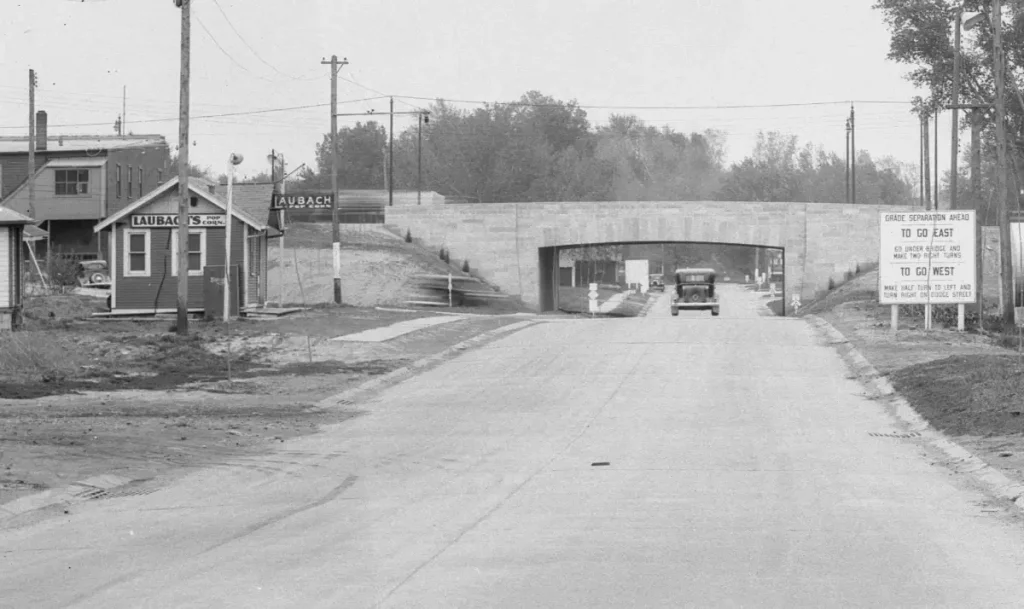
1935 Durham Museum photo looking south on Saddle Creek Road from about Capitol Avenue after the bridge was constructed.
From the Bostwick-Frohardt/KMTV Photograph Collection, permanently housed at The Durham Museum.
The project will be led by Omaha-based Hawkins Construction, which has extensive bridge experience including the Heaney Pedestrian Bridge, which spans Highway 75 and connects Creighton University to the Atlas Apartments in Gifford Park, as well as the Baby Bob connector bridge that links to the Bob Kerrey Pedestrian Bridge.
For now, the Saddle Creek Underpass stands as Nebraska’s first major interchange and one of its first two concrete rigid-frame bridges. Built by men desperate for work, the bridge has outlasted not just the Lincoln Highway but the streetcars that once ran across it. More impressive is that it remains in use even as the city’s population has more than doubled.