A major infrastructure project planned for northwest Omaha is designed to bring a decades-old interchange in line with rapid growth in the area, but not without some short-term disruptions for drivers.
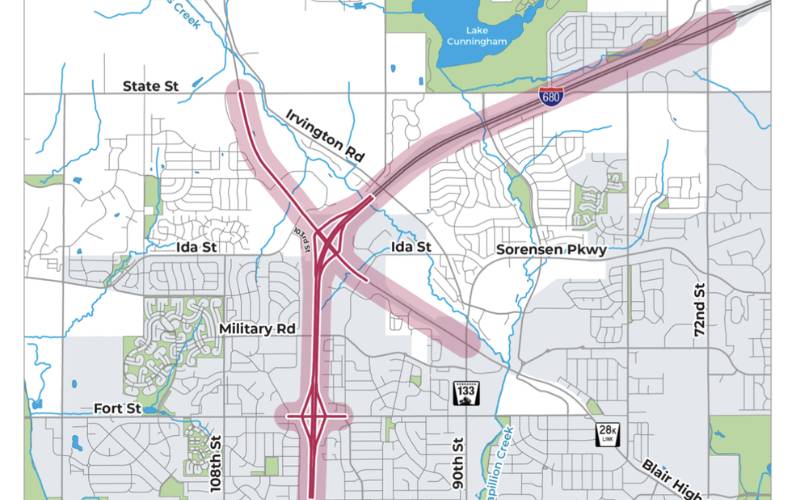
The Nebraska Department of Transportation (NDOT) is preparing for a significant reconstruction of the Interstate 680 corridor between Fort Street and the Blair High Road interchange. According to NDOT District 2 project delivery engineer Damion Stern, the goal is to transform what was once a rural-style highway into a modern, urbanized roadway built to handle today’s traffic demands.
“The majority of this project is going to compress the area between Fort Street and Blair High Road,” Stern said. “Right now, it’s a four-lane divided highway and we’re going to more or less reconstruct it and urbanize it.”
Plans call for adding a lane in both directions, installing a median barrier, upgrading storm sewer systems and redesigning portions of the interchange. New loop ramps, that are currently not in place, will also be added to improve traffic flow and reduce backups.
The project extends beyond the interstate itself. Blair High Road will be reconstructed from roughly Ida Street near the Walmart intersection north to State Street. That stretch has seen significant growth in recent years, with increased traffic coming from nearby areas like Blair and Bennington, as well as surrounding subdivisions.
“That area has gotten overloaded over the last several years,” Stern said. “We’ll be making improvements to help with flow and access to the interchange.”
One of the most visible changes will occur at Fort Street, where two existing bridges will be replaced with a single, shared bridge spanning the corridor. At the Blair High Road Interchange, however, the existing bridge will remain in place, undergoing modifications rather than a full replacement.
Construction is currently scheduled to begin in 2029 and is expected to last two years, though Stern noted that timeline could change.
“There is a chance this is going to slip at least a year, to 2030,” he said, citing other major infrastructure projects in the metro area that could take priority or overlap with this work.
When construction does begin, drivers should prepare for delays. NDOT plans to maintain one lane of traffic in each direction throughout the project, but ramp closures and detours are likely.
“Drivers can envision today the backups that occur on a daily basis,” Stern said. “With construction, it’s going to be worse. There’s going to be some patience that needs to occur over the life of the project.”
The need for the project stems from the age and original design of the interchange, which was built roughly 50 years ago when the surrounding area was far less developed.
“This was really a rural interchange,” Stern said. “The traffic volumes really weren’t there at that time.”
Today, increased demand, especially along Blair High Road, has led to congestion issues, including backups that extend onto interstate ramps. The redesign aims to address those problems by increasing capacity and creating more efficient traffic patterns.
NDOT planners are also looking ahead, designing the project based on projected traffic growth over the next 20 years. However, Stern acknowledged that predicting long-term demand isn’t always exact.
“There are a lot of areas where we could build this and day one it’s congested again,” he said. “Economic drivers, urban development, it can be very difficult to predict.”
As the project moves forward, NDOT says key project changes will be shared through social media, local news outlets and their website. Residents with questions should reach out directly to NDOT’s district construction office or communications team through their website.