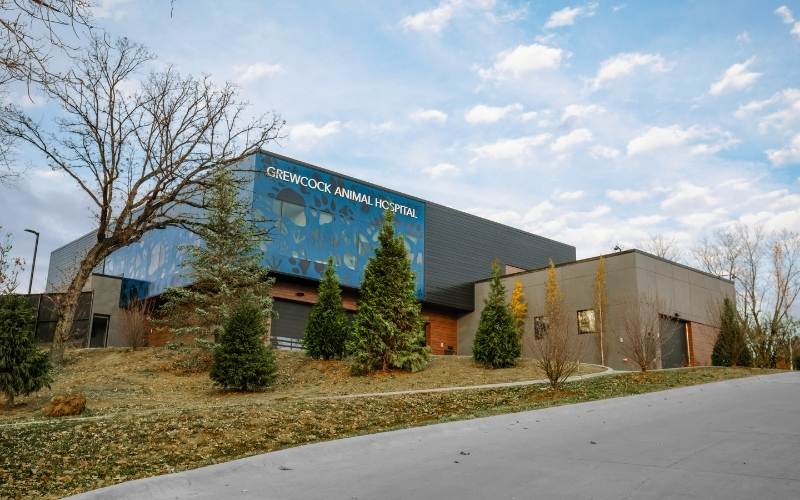
Omaha’s Henry Doorly Zoo and Aquarium officially opened the Bill and Berniece Grewcock Animal Hospital, a 32,000 sq. ft., state-of-the-art facility designed “to support the depth and complexity of modern zoological medicine,” according to a press release.
Located on the northeast side of the Zoo, the new hospital replaces a 30-year-old facility, and equips the Zoo’s animal health and care teams with expanded space and advanced medical technology to provide care for the zoo’s 39,000 animals, from invertebrates to large mammals.
The hospital brings together core medical services under one roof, including dedicated spaces for quarantine and hospitalization, intensive care unit wards and an animal diet kitchen. A fully equipped pharmacy and in-house clinical pathology laboratory support rapid diagnostics, while two treatment rooms and a sterile surgical suite support efficient, expert care from routine exams to the most complex medical cases.
A major advancement within the facility is the zoo’s first-ever computed tomography (CT) scanner, which significantly enhances diagnostic imaging and clinical decision-making. The hospital also features medical technology that supports advanced, minimally invasive procedures, expanding treatment options while reducing recovery time.
“This hospital represents a meaningful evolution in how we care for animals,” said Dr. Luis Padilla, DVM, Dipl. ACZM, president and CEO of Omaha’s Henry Doorly Zoo and Aquarium. “It reflects our responsibility to the animals in our care and our commitment to advancing animal health through innovation, collaboration, and excellence in medicine.”
The expanded size and capabilities of the hospital also support continuous patient monitoring through integrated video systems, enabling veterinary teams to observe animals without disruption and respond quickly to changes in condition.
With the opening of the hospital, the zoo is joining a zoological medicine residency program through the American College of Zoological Medicine, one of only 32 in the country. The program leverages the hospital’s advanced diagnostics and resident experts to train future leaders in zoo and wildlife medicine through hands-on experience in a high-performing medical environment, expanding impact far beyond Omaha.
The hospital was designed as a hands-on learning environment that makes advanced veterinary medicine visible and accessible for training and collaboration. Two-way audio and an integrated video systems allows veterinarians to communicate with each other and with students in the viewing areas, while video conferencing capabilities and cameras built into surgical lighting make it possible to share close, real-time views of procedures with partners around the world.
“This facility changes what is possible for our teams and our patients,” said Dr. Taylor Yaw, DVM, CertAqV, Dipl. ACZM, Dipl. ABVP (Fish Practice), Vice President of Science and Animal Health. “It allows us to keep learning, improving, and, most importantly, share our expertise, serving as a resource and partner to institutions across the state and country.”
The project was made possible through the generosity of more than 10,000 donors. The animal health team has begun treating patients in the facility and will begin moving in early February. The hospital is not accessible to the public.
Photo courtesy of Omaha’s Henry Doorly Zoo and Aquarium